Looking for a reliable connection hint source before Forbes drops today’s coverage? Puzzle fans have made checking in with trusted outlets like Forbes part of their daily routine, since the site consistently breaks down each NYT Connections Forbes grid with clear, spoiler-conscious guidance. Whether you’re chasing a daily streak or just want a nudge on that stubborn purple category, a good hints roundup saves you from blind guessing and wasted attempts.
This guide follows that same approach offering category clues first, then a full answer breakdown for anyone ready to see the solution. If you’ve relied on Forbes-style Connections coverage before, you’ll feel right at home with the structure here.
What are NYT Connections Forbes?
NYT Connections is a daily word association puzzle published by The New York Times, created by associate puzzle editor Wyna Liu. Each puzzle presents a 4×4 grid of 16 words, and your job is to sort them into four hidden groups of four based on a shared category or theme.
Since its June 2023 launch, Connections has become one of the most popular entries in the NYT Games lineup, sitting right behind Wordle in daily engagement. Part of the appeal is the puzzle’s clever misdirection: words that look like they belong together often don’t, which is exactly what makes the game so addictive.
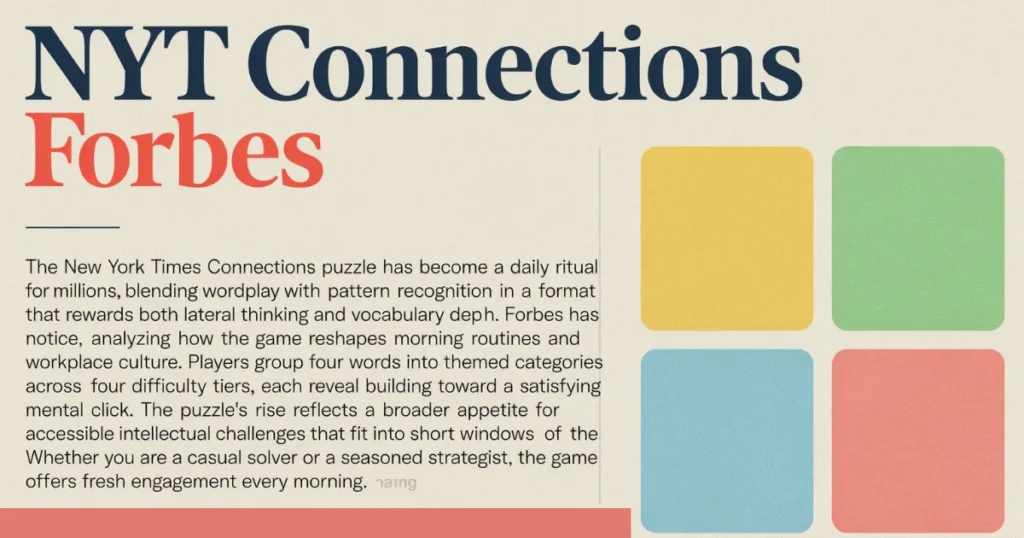
Each group is color-coded by difficulty:
| Color | Difficulty | What to Expect |
| 🟡 Yellow | Easiest | Straightforward, obvious theme |
| 🟢 Green | Medium | Slightly trickier wording |
| 🔵 Blue | Hard | Requires lateral thinking |
| 🟣 Purple | Hardest | Wordplay, puns, or hidden patterns |
How to Play NYT Connections Forbes
- You’re given 16 words in a randomized grid.
- Select four words you believe share a common thread.
- Tap Submit to check your guess.
- If correct, that group locks in and displays its category name.
- If wrong, you’ll sometimes see a “one away” message, meaning you’re close.
- You get four mistakes total before the game ends.
A few tips baked into the mechanics:
- You can shuffle the board if the word order is throwing you off.
- Some words seem to fit multiple categories; this is intentional misdirection.
- Only one correct grouping exists per puzzle, even if others look plausible.
- A new puzzle resets at midnight in your local time zone, giving you 24 hours to solve it.
You can play Connections for free on the NYT Games website or through the NYT Games app on mobile.
Today’s NYT Connections Hints (No Spoilers)
Want to solve it yourself? Here are gentle nudges for Puzzle #1126 (July 11, 2026)no direct answers yet:
- 🟡 Yellow hint: Think about what you’d see under the big top at a circus.
- 🟢 Green hint: These words describe water that’s completely motionless.
- 🔵 Blue hint: All four are characters from a beloved animated movie franchise.
- 🟣 Purple hint: This one’s a letter-pattern trick, not a theme look closely at where a repeated letter sits in the alphabet.
If those hints didn’t crack it, scroll down for the category themes, or skip further for the full answer reveal.
Today’s NYT Connections Category Themes
Before revealing the actual words, here are today’s four group themes for Puzzle #1126:
- Circus Equipment
- Undisturbed, As Water
- “Toy Story” Characters
- Double Letters Appearing in That Letter’s Alphabetical Position
That last purple category is a classic NYT wordplay curveball; it’s less about meaning and more about a hidden orthographic pattern, which is exactly why it stumped so many solvers today.
Today’s NYT Connections Forbes Answers (Full Reveal)
⚠️ Spoiler warning here are the complete answers for Connections #1126, July 11, 2026:
| Group | Category | Words |
| 🟡 Yellow | Circus Equipment | CANNON, STILTS, TRAPEZE, UNICYCLE |
| 🟢 Green | Undisturbed, As Water | CALM, FLAT, GLASSY, STILL |
| 🔵 Blue | “Toy Story” Characters | BO PEEP, JESSIE, SLINKY, WOODY |
| 🟣 Purple | Double Letters at That Letter’s Alphabetical Position | AARDVARK, BOCCE, EBBING, TWIDDLE |
The purple group works like this: each word contains a doubled letter that sits at that exact position in the alphabet (A is 1st, B is 2nd, and so on) a satisfying “aha” once it clicks, but nearly impossible to spot without a hint.
Overall, today’s puzzle leaned easy through the first three categories, with the letter-position twist in purple being the only real roadblock, a common pattern for NYT’s trickiest tier.
Tips & Strategies to Solve Connections Faster
Want to improve your solve time and protect your streak? Try these proven strategies:
- Start with your most confident group first. Locking in an easy yellow or green category thins out the board and makes remaining connections easier to spot.
- Watch for red herrings. Words that seem to belong to an obvious category (like a brand name or synonym set) are often deliberately placed to mislead you.
- Don’t ignore wordplay. If a set of words doesn’t share an obvious meaning, consider hidden patterns of homophones, compound words, or letters hiding inside the term.
- Use the “one away” signal wisely. If you’re told you’re one word off, swap out your least confident pick rather than guessing blindly.
- Save purple for last. It’s almost always a trick category puns, wordplay, or structural patterns rather than plain synonyms.
- Shuffle when stuck. Rearranging the grid visually can help your brain spot connections it missed in the original layout.
- Think about double meanings. Many Connections puzzles hide a category based on an alternate definition of a common word.
More NYT Daily Games Hints & Answers
If you enjoy Connections, the NYT Games suite has plenty more daily puzzles to explore:
- Wordle guess the five-letter word in six tries
- NYT Strands find themed words hidden in a letter grid
- NYT Mini Crossword a bite-sized daily crossword
- Pips NYT’s numeric logic puzzle
- Spelling Bee build words from seven letters
- Letter Boxed connect letters to form words without lifting your finger
Each of these games follows the same daily-reset structure as Connections, refreshing at midnight local time.
Previous Connections Answers (Archive)
Missed a day? Here’s a quick look back at recent puzzles:
| Date | Puzzle # | Categories |
| July 11, 2026 | #1126 | Circus Equipment; Undisturbed, As Water; Toy Story Characters; Double-Letter Alphabet Positions |
| July 10, 2026 | #1125 | Smartphone Settings; Dessert Menu Descriptors; ’80s Synth-Pop Bands; Starting With Baseball Calls |
| July 9, 2026 | #1124 | Non-Alcoholic Designators; Music Publications; Kinds of Rugs; Pontiac Models |
July 10 (#1125) full answers:
- Smartphone Settings: AIRPLANE MODE, DO NOT DISTURB, HOTSPOT, LOCATION SERVICES
- Dessert Menu Descriptors: DECADENT, FRESH-BAKED, MOLTEN, À LA MODE
- ’80s Synth-Pop Bands: DEPECHE MODE, ERASURE, NEW ORDER, PET SHOP BOYS
- Starting With Baseball Calls: BALL GOWN, OUT LAST, SAFE MODE, STRIKE A POSE
July 9 (#1124) full answers:
- Non-Alcoholic Designators: NA, SPIRIT-FREE, VIRGIN, ZERO-PROOF
- Music Publications: BILLBOARD, PITCHFORK, ROLLING STONE, SPIN
- Kinds of Rugs: PERSIAN, PRAYER, SHAG, THROW
- Pontiac Models: FIREBIRD, G6, GRAND PRIX, TRANS AM
Bookmark this page and update it daily with fresh hints, category themes, and full answers for every new Connections puzzle.
FAQs About NYT Connections Forbes
What is NYT Connections #1126?
Puzzle #1126 is the July 11, 2026 edition of NYT Connections, featuring categories on circus equipment, calm water, Toy Story characters, and a hidden double-letter wordplay trick.
How many mistakes are allowed in Connections?
You get four mistakes total before the puzzle ends, so it’s best to start with your most confident group.
What time does a new Connections puzzle drop?
A fresh puzzle releases at midnight local time in your specific time zone, giving everyone 24 hours to solve it.
Is NYT Connections free to play?
Yes, Connections is free to play on the NYT Games website and app, though full puzzle archives require an NYT Games subscription.
Can I play past Connections puzzles?
Yes, but accessing the full archive of previous puzzles typically requires an active NYT Games subscription.
Why is the purple category always the hardest?
Purple categories usually rely on wordplay, puns, or hidden patterns rather than straightforward meaning, making them the trickiest to spot.