Financial markets no longer move at the pace of newspapers and phone calls. They move in milliseconds, driven by data pipelines, predictive models, and platforms built to make sense of it all FTAsiaStock Technology sits at the center of this shift, offering traders and businesses a smarter way to read markets, manage risk, and act with confidence.
This article breaks down what the technology actually does, how it compares to older ways of analyzing stocks, and why it’s becoming a reference point for anyone studying digital trading platforms and fintech innovation.
What is FTAsiaTrading Technology?
FTAsiaTrading technology refers to a data-driven financial framework that combines artificial intelligence, automation, cloud computing, and cybersecurity into one connected system for analyzing and executing trades. Rather than treating market analysis, security, and execution as separate tasks, it links them into a single workflow.
At a basic level, the system:
- Collects real-time market data from exchanges, indices, and financial news sources
- Processes that data using algorithmic models and machine learning
- Converts raw numbers into actionable insights for traders and analysts
- Executes or supports trades with speed and accuracy that manual methods can’t match
It’s less a single product and more an ecosystem one built to help both individual investors and institutions respond to fast-moving markets without drowning in information.
Evolution of Stock Market Analysis ,Before vs After Technology
Understanding the value of this technology is easier when you compare how market analysis used to work against how it works now.
| Aspect | Before Technology | After FTAsiaTrading-Style Technology |
| Data access | End-of-day reports, delayed updates | Real-time data streamed continuously |
| Analysis method | Manual chart reading, intuition | AI-driven pattern recognition |
| Speed of execution | Minutes to hours | Milliseconds |
| Risk management | Reactive, after losses occurred | Predictive analytics flag risks in advance |
| Accessibility | Limited to institutions and brokers | Available to retail investors via apps |
| Record keeping | Paper trails, manual ledgers | Blockchain-backed transaction records |
The shift hasn’t just made trading faster — it has changed who gets to participate. A retail investor today has access to tools that were once reserved for large trading desks.
Key Components of FTAsiaTrading’s Data-Driven Approach
A data-driven approach only works if the underlying components are built to talk to each other. Here are the core building blocks:
- Data aggregation layer pulls information from stock exchanges, commodities markets, and currency feeds
- Analytics engine applies statistical models and machine learning algorithms to detect patterns
- Dashboard and visualization tools turn complex datasets into charts and alerts a human can actually use
- Execution infrastructure handles order placement with minimal latency
- Security layer protects transactions and personal data through encryption
Each layer feeds the next. Data without analysis is noise; analysis without a clean interface is wasted effort. This is why market intelligence platforms increasingly focus on the full pipeline rather than one isolated feature.
Role of Artificial Intelligence in Smarter Market Analysis
Artificial intelligence is arguably the most talked-about piece of this puzzle, and for good reason. AI systems can scan historical data and live feeds simultaneously, spotting correlations a human analyst might miss simply due to volume.
Some practical applications include:
- Predictive analytics that forecast possible price movements based on historical trends
- Sentiment analysis that scans news and social media for shifts in market mood
- Anomaly detection that flags unusual trading volume or price behavior
- Portfolio recommendations based on risk tolerance and past performance
AI doesn’t replace analysis, it accelerates it. Traders still need to interpret what the model surfaces, but they’re no longer starting from a blank spreadsheet.
Automation: Making Trading Faster and More Efficient
Automated trading systems remove a lot of the repetitive, time-sensitive work that used to eat up a trader’s day. Instead of manually placing every order, traders can set rules and let the system execute when conditions are met.
Benefits of automation in this space include:
- Faster trade execution with reduced human delay
- Consistent application of a trading strategy, without emotional interference
- 24/7 market monitoring, even outside standard working hours
- Reduced operational costs for firms managing large transaction volumes
A simple example: a trader sets a rule to sell if a stock drops 5% below its purchase price. The system executes that instantly, without waiting for the trader to notice the dip themselves.
Cybersecurity Building Trust in Digital Trading Platforms
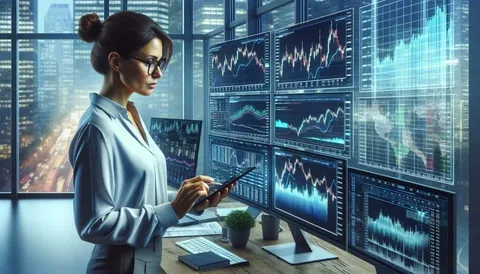
None of this matters if users can’t trust the platform with their money and data. Cybersecurity is a foundational, not optional, part of any serious trading technology.
Common protective measures include:
- Data encryption for transactions and stored information
- Multi-factor authentication to prevent unauthorized account access
- Blockchain-based audit trails that make transaction histories tamper-resistant
- Continuous monitoring for unusual login or trading activity
Trust is built slowly and lost quickly. Platforms that invest in strong digital security tend to retain users longer, simply because people are more willing to trade when they believe their funds and information are protected.
Why Human Judgment Still Matters Alongside Technology
It’s tempting to assume AI and automation can run the show entirely, but that’s not quite accurate. Human judgment remains essential for a few reasons:
- Markets are influenced by geopolitical events, policy shifts, and behavior that models can’t always anticipate
- Algorithms are only as good as the data and assumptions they’re built on
- Ethical and strategic decisions like how much risk a business is willing to accept still require human context
The most effective approach blends technology-driven insights with experienced human oversight. Technology narrows down the options and speeds up analysis; people still decide what actually matters in context.
How This Technology Is Helping Businesses and Investors
The impact isn’t limited to large financial institutions. Smaller businesses and individual investors are seeing real, practical benefits too.
| User Type | Key Benefit |
| Retail investors | Access to real-time market data once limited to institutions |
| Small businesses | Lower-cost tools for financial monitoring and reporting |
| Institutional traders | Faster execution and deeper risk management capabilities |
| Startups | Scalable, cloud-based infrastructure without heavy upfront investment |
This democratization of tools is one of the more meaningful shifts in modern finance — the gap between what a large institution can access and what an individual trader can access has narrowed considerably.
Future Trends: What’s Next for FTAsiaTrading Technology
Looking ahead, a few trends are likely to shape where this technology heads next:
- Deeper AI integration, including more advanced predictive models trained on broader datasets
- Wider adoption of blockchain systems for transparent, verifiable transaction records
- Increased focus on ESG-aligned and sustainable trading practices
- Greater use of mobile-first platforms to reach investors in emerging markets
- Continued investment in cybersecurity as digital trading volumes grow
None of these trends exist in isolation; they reinforce each other. Better AI needs better data; better data needs stronger security; stronger security builds the trust that keeps users on the platform.
FAQs
What is FTAsiaTrading technology in simple terms?
It’s a technology framework combining AI, automation, and data analytics to help traders and businesses analyze markets and execute trades more efficiently.
Is AI replacing human traders?
No. AI speeds up analysis and execution, but human judgment is still needed for context, strategy, and ethical decision-making.
How does automation improve trading?
Automation executes trades based on pre-set rules instantly, removing delays and emotional decision-making from the process.
Why is cybersecurity important in digital trading?
It protects user funds and data from unauthorized access, which builds the trust needed for people to use digital platforms confidently.
Can small investors benefit from this technology?
Yes. Many tools once limited to large institutions, like real-time data and predictive analytics, are now available through affordable, accessible platforms.
Conclusion
FTAsiaTrading technology represents a broader shift in how markets are analyzed, secured, and traded, one built on real-time data, AI-driven insight, automation, and strong digital security. It hasn’t eliminated the need for human judgment, but it has made market analysis faster, more accessible, and more informed than it was a decade ago.
Key takeaways:
- Technology has moved market analysis from delayed, manual methods to real-time, data-driven decision-making
- AI and automation improve speed and consistency, but human oversight still matters
- Strong cybersecurity is what makes digital trading trustworthy in the long run
- These tools are increasingly accessible to individual investors, not just institutions