

Artificial intelligence is changing how people search for information, learn new skills, create content, and solve everyday problems. This beginner-friendly guide explains artificial intelligence, AI applications, AI apps, and machine learning, including how these technologies work, where they are useful, what risks to consider, and how to begin learning about AI in 2026.
Artificial Intelligence Explained: How AI Works and Where It Is Used
Introduction
Artificial intelligence is no longer just a topic for science fiction or computer science laboratories. It appears in everyday digital experiences, from the recommendations people see on streaming platforms to the voice assistants that answer questions and the software that helps businesses analyze information.
For beginners, however, the terminology can be confusing. Artificial intelligence, machine learning, deep learning, generative AI, and AI analytics are related, but they do not all mean the same thing. Some tools recognize patterns in data, some make predictions, and others generate text, images, or code.
This guide explains these ideas in plain English. You will learn how AI works, understand common AI applications, explore practical examples, and discover how to use AI tools more responsibly. You do not need an advanced mathematics or programming background to understand the fundamentals.
What Is Artificial Intelligence?
Artificial intelligence, commonly called AI, is a field of computer science focused on building systems that perform tasks associated with human intelligence. These tasks can include recognizing images, understanding language, identifying patterns, making predictions, and supporting decisions.
The term describes a broad collection of techniques rather than one particular app or machine. An AI system might classify an email as spam, recommend a song, summarize a document, or generate a response to a question.
Artificial intelligence definition in simple words
A simple artificial intelligence definition is: technology that enables computers to perform tasks that normally require capabilities such as learning, pattern recognition, language processing, or problem-solving.
That does not mean every AI system thinks like a human. Many systems use mathematical models and patterns learned from data to produce an output. A tool may generate a convincing answer without having human experiences, emotions, or a complete understanding of the situation.
For example, an email service can learn to recognize patterns associated with spam messages. It does not need to understand a message in the same way a person does to estimate whether the message belongs in a spam folder.
Why AI matters in 2026
AI matters because it can help people process information, automate repetitive work, and interact with software using everyday language. Students can use it to explore a difficult concept, professionals can use it to organize notes, and small businesses can use it to analyze customer feedback.
Its value depends on the task, the quality of the system, and the way people use its results. AI is not automatically the best solution to every problem, and human judgment remains important.
How Does Artificial Intelligence Work?
AI systems differ in design, but many modern systems follow a basic process: they receive information, process it using a model, and produce an output.

1. Data provides examples
Data may include text, images, audio, measurements, or other information. During development, an AI model may be trained on examples that help it learn patterns relevant to a task.
For instance, a model designed to identify objects in pictures may be trained using many images with labels. The examples help the system learn which visual features are associated with different objects.
The quality and suitability of the data matter. Incomplete, inaccurate, or unrepresentative data can contribute to unreliable or unfair results.
2. A model learns patterns
A model is a computational system that maps inputs to outputs. During training, its parameters may be adjusted so that its results better match a learning objective.
The exact process depends on the model. Some systems learn from labeled examples, while others learn useful representations from large collections of data. Not all AI learns continuously from each interaction; many deployed models remain unchanged until their developers update or retrain them.
3. The system produces an output
After training, an AI system can receive new information and produce a prediction, classification, recommendation, or generated response.
Imagine entering a question into an AI assistant. The system processes the text and generates an answer based on the model, its training, and the instructions or context it receives. The response may be useful, but it can also be incomplete or incorrect.
4. People evaluate the result
The final step should be checking whether the output is appropriate. A person may verify facts, compare recommendations with trusted information, correct errors, or decide not to use the result.
This matters especially when AI is used for health, finance, employment, education, legal issues, or other high-impact decisions.
AI vs. Machine Learning vs. Deep Learning
These terms are connected, but they describe different levels or approaches.
| Term | Meaning | Example |
|---|---|---|
| Artificial intelligence | The broad field of systems performing tasks associated with intelligence | A virtual assistant |
| Machine learning | An approach in which models learn patterns from data | Detecting suspicious transactions |
| Deep learning | Machine learning that uses neural networks with multiple layers | Recognizing objects in images |
| Generative AI | AI designed to generate content such as text, images, audio, or code | Drafting a summary |
What is machine learning?
Machine learning (ML) is a branch of AI in which computer systems learn patterns from data to make predictions, classifications, or other outputs without needing every decision to be manually specified as a separate rule.
A practical machine learning definition is a method of using data and algorithms to train a model that can perform a task on new examples.
Consider a retailer that wants to estimate future demand. A machine learning model might examine historical sales, seasonality, and other relevant information to forecast which products may sell more often. The forecast can support planning, but it is not guaranteed to be correct.
What does machine learning mean in practice?
Machine learning meaning becomes clearer when you consider everyday examples:
- A music service recommends songs based on listening patterns.
- A bank’s systems flag transactions that appear unusual.
- A retailer estimates which products may need restocking.
- A photo app groups images using visual similarities.
Machine learning models are only as useful as their data, evaluation, and implementation. A model can perform well on familiar examples but struggle when real-world conditions change.
Where deep learning fits
Deep learning is a type of machine learning that uses neural networks with multiple computational layers. It is especially useful for complex data such as language, images, and audio.
Many modern generative AI systems rely on deep learning. However, not every AI application uses deep learning, and not every machine learning model is a neural network.
Common Types of Artificial Intelligence
AI can be grouped by what a system does and how it is built. The following categories are useful starting points for beginners.
Natural language processing
Natural language processing (NLP) helps computers work with human language. Applications include text classification, translation, summarization, speech transcription, and conversational assistants.
An NLP tool might summarize a long report or help organize customer comments by topic. Its output still needs review when the wording, context, or details matter.
Computer vision
Computer vision allows systems to analyze images and video. Examples include recognizing objects, reading text from scanned documents, identifying manufacturing defects, and helping organize photographs.
Performance depends on the image quality, training data, and conditions in which the system operates.
Predictive AI and analytics
Predictive systems use data to estimate likely outcomes. AI analytics can help identify patterns, summarize information, or support forecasts.
For example, a business may examine historical sales and seasonal trends to estimate future demand. The results should be treated as evidence for decision-making, not as certainty about the future.
Generative AI
Generative AI creates new content based on patterns learned during training and the instructions it receives. Depending on the tool, it can produce text, images, audio, video, or computer code.
A user might ask a generative AI system to outline a presentation, explain a technical term, or suggest several ways to structure an article. The output is a starting point that may require fact-checking and editing.
Real-World AI Applications
AI applications are already used across many sectors. Their purpose is usually to support a particular task, improve an existing process, or help people work with large amounts of information.
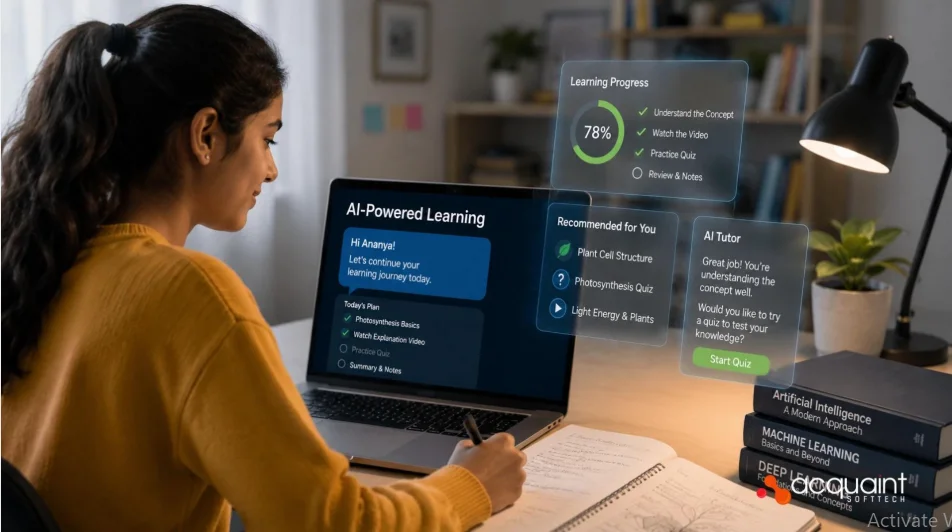
Education and learning
Students can use AI tools to explore unfamiliar concepts, generate practice questions, organize study plans, or receive explanations at different difficulty levels.
For example, a student learning basic statistics could ask an AI assistant to explain averages using a simple example. The student should then check the explanation against course materials and practice solving problems independently.
AI should support learning rather than replace it. Submitting generated work as one’s own may violate school or university rules.
Healthcare and research
AI can assist with tasks such as analyzing medical images, organizing research information, and identifying patterns in health data. Its role varies by application, and clinical use requires appropriate validation and professional oversight.
A general-purpose AI chatbot should not be treated as a substitute for a qualified clinician. Health decisions require reliable evidence and consideration of an individual’s circumstances.
Business and customer support
Businesses use AI to classify customer messages, summarize documents, analyze feedback, support inventory planning, and help staff find information.
A support team, for example, might use an AI tool to draft a response to a common question. A staff member can review the draft for accuracy, tone, and company policy before sending it.
Finance and fraud detection
AI and machine learning can help identify unusual transactions, organize financial information, and support risk analysis. These systems may help analysts prioritize cases for review.
An alert does not prove that fraud has occurred. Incorrect data or unusual but legitimate activity can also trigger a warning, so investigation and appropriate controls remain necessary.
Everyday technology
People may encounter AI in search features, spam filters, translation tools, recommendation systems, phone cameras, accessibility tools, and digital assistants.
You do not need to install a dedicated AI app to benefit from the technology. AI features may already be integrated into software and services you use.
AI Apps: How to Choose a Useful Tool
An AI app is a software application that uses one or more AI capabilities. Some help with writing and research; others focus on images, transcription, coding, translation, data analysis, or organization.
The right tool depends on what you need to accomplish, rather than how many features it advertises.
Common categories of AI apps
- Writing and research assistants: Help brainstorm, outline, summarize, or revise text.
- Image tools: Generate or edit images and assist with visual tasks.
- Coding assistants: Explain code, suggest changes, and help identify potential errors.
- Data analysis tools: Help interpret tables, explore trends, or produce summaries.
- Voice and transcription apps: Convert speech to text or assist with spoken interactions.
- Productivity tools: Help organize notes, draft messages, and structure routine tasks.
These categories overlap, and features vary across products and subscription plans.
How to evaluate a free AI app
If you are looking for an AI app free of charge, review more than the price. A free plan may have usage limits, fewer features, slower processing, or restrictions on commercial use.
Before signing up, check:
- Purpose: Does the tool perform the task you actually need?
- Privacy: What happens to prompts, uploaded documents, and personal information?
- Accuracy: Can you verify the output with dependable sources?
- Limits: Are there daily quotas, file-size restrictions, or paid-only features?
- Ownership and permissions: What rights apply to generated content?
- Accessibility: Is the interface usable on your device, and does it support the features you need?
Avoid uploading confidential business records, sensitive personal details, passwords, or private customer information unless the service has been approved for that use and its data practices are suitable.
Benefits of Artificial Intelligence
AI can provide meaningful benefits when applied to appropriate tasks.
Efficiency and automation
AI can help handle repetitive activities such as sorting messages, drafting routine text, or extracting information from documents. This can give people more time for work requiring judgment, communication, or creativity.
Automation still needs monitoring. A fast process is not necessarily a good process if it produces errors at scale.
Working with large amounts of information
AI systems can help organize, classify, or summarize information that would take people longer to review manually. Analysts can use these outputs to identify areas that deserve closer attention.
The results should be checked for missing context, incorrect assumptions, and misleading summaries.
Accessibility and personalization
Speech recognition, text-to-speech, translation, and adaptive interfaces can make some digital tasks more accessible. Recommendation and learning tools can also tailor content to user preferences.
However, personalization depends on data and design choices. Users should have reasonable control over how their information is collected and used.
Supporting creativity and problem-solving
AI can suggest alternative outlines, generate initial ideas, explain different approaches, or help users experiment with concepts. It is often most helpful as a collaborator whose work people refine rather than accept automatically.
Limitations and Risks of AI
Understanding limitations is as important as understanding capabilities.

Inaccurate or fabricated answers
Generative AI can produce statements that sound confident but are wrong. It may invent details, misinterpret a question, or provide outdated information.
Verify important claims against primary sources. For technical work, test code; for research, check the original study; for current events, consult reliable and recent reporting.
Bias and unfair outcomes
AI systems can reflect biases in their training data, labels, design, or deployment environment. If a model is used to screen applications or allocate resources, poor evaluation can lead to unfair results.
Organizations should assess systems for relevant risks, monitor performance, and provide appropriate human review and ways to challenge important decisions.
Privacy and security
Prompts and uploaded files may contain personal or confidential information. Different AI services have different retention, access, and training policies.
Read the provider’s privacy information, use approved accounts and settings, and avoid entering sensitive data unnecessarily. Be alert to scams, impersonation, and AI-generated messages designed to manipulate people.
Overreliance and loss of skills
Relying on AI for every task can weaken independent practice or cause people to accept mistakes without noticing them. Students should still learn foundational concepts; professionals should maintain the skills needed to evaluate their tools.
A practical rule is to use AI to support your thinking, not to switch off your judgment.
Job changes and human responsibility
AI can automate some tasks and change how other jobs are performed. The impact varies by industry, role, and how organizations introduce the technology. It is not accurate to assume that every job will disappear or that every worker will benefit equally.
People and organizations can prepare by learning relevant tools, strengthening communication and analytical skills, and reviewing how responsibilities are changing.
How to Start Learning Artificial Intelligence in 2026
You can begin without becoming a machine learning engineer. Start with the concepts and tools that relate to your interests, then build deeper technical knowledge if you want to.
Step 1: Learn the vocabulary
Understand the difference between AI, machine learning, deep learning, generative AI, algorithms, models, and training data. These concepts provide a foundation for evaluating claims about new tools.
Step 2: Experiment with a low-risk task
Choose a simple task such as summarizing a public article, generating study questions, or organizing non-confidential notes. Compare the AI output with your own work and identify what it gets right or wrong.
Step 3: Practice writing clear instructions
Useful prompts explain the goal, audience, context, constraints, and desired format. For example:
“Explain machine learning to a beginner in 200 words. Include one everyday example and three limitations. Avoid technical jargon.”
Specific instructions usually make it easier to evaluate whether the response meets your needs, although they do not guarantee accuracy.
Step 4: Verify the results
Check factual statements against reliable sources. Ask the tool to identify uncertainty where useful, but do not treat that request as proof that its answer is correct.
For research, look for original documentation, academic institutions, government resources, and reputable technical publications.
Step 5: Explore basic data and programming skills
If you want to build AI systems, begin with basic statistics, data literacy, and Python programming. Then learn how datasets are prepared, how models are trained and evaluated, and why performance can change on new data.
You do not need to learn all of this before using everyday AI tools. The appropriate learning path depends on whether your goal is general literacy, workplace productivity, or technical development.
Step 6: Build a small project
Try a modest project, such as categorizing a collection of public comments, creating a study-question generator, or analyzing a non-sensitive sample dataset. Define the task, check the output, document limitations, and explain what you learned.
A small, carefully evaluated project can teach more than simply trying many tools without a clear objective.
The Future of Artificial Intelligence: What to Watch in 2026
AI will continue to be an important area to follow, but specific future capabilities, regulations, prices, and job effects should not be treated as guaranteed. For 2026, it is more useful to watch developments through practical questions.
- Reliability: Do newer systems make fewer errors on tasks that matter to you?
- Transparency: Can users understand the limitations, data practices, and intended use of a tool?
- Integration: Does AI work safely and effectively with existing software and workflows?
- Privacy and security: Are providers improving safeguards against data exposure, misuse, and manipulation?
- Evaluation: Are organizations measuring real performance instead of relying on impressive demonstrations?
- Skills: Are schools and employers helping people learn to use AI responsibly?
For beginners, the best response to rapid change is not to chase every new release. Learn the fundamentals, test tools on suitable tasks, protect your information, and keep checking the quality of the results.
Frequently Asked Questions
1. What is artificial intelligence in simple words?
Artificial intelligence is technology that enables computer systems to perform tasks such as recognizing patterns, processing language, making predictions, and generating content. Different AI systems are designed for different purposes.
2. What is the difference between AI and machine learning?
AI is the broad field of creating systems that perform tasks associated with intelligence. Machine learning is one approach within AI that trains models to learn patterns from data and apply them to new examples.
3. Is machine learning the same as deep learning?
No. Deep learning is a type of machine learning that uses neural networks with multiple layers. Machine learning also includes approaches that do not use deep neural networks.
4. What are common AI applications?
Common applications include spam filtering, recommendations, translation, speech transcription, image recognition, document summarization, data analysis, and generative content tools. Their accuracy and suitability depend on the task and implementation.
5. Can beginners use AI apps for free?
Yes, some services offer free access or limited free plans. Features, usage limits, privacy terms, and commercial permissions vary, so review the current terms before choosing a tool.
6. Can artificial intelligence make mistakes?
Yes. AI may produce inaccurate information, miss context, reflect biased data, or fail when conditions differ from its training examples. Important outputs should be verified, particularly in high-impact situations.
7. Do I need to know coding to learn AI?
No. You can learn AI concepts and use many everyday AI applications without coding. Programming, statistics, and data skills become useful if you want to develop, test, or customize AI systems.
8. How can I use AI responsibly?
Choose suitable tools, protect confidential information, verify important results, check for bias, follow workplace or school rules, and keep a human responsible for consequential decisions.
Conclusion
Artificial intelligence is a broad set of technologies that can help people recognize patterns, process information, automate selected tasks, and create new content. Understanding the difference between AI, machine learning, deep learning, and generative AI makes it easier to see what a tool can—and cannot—do.
For beginners in 2026, a sensible approach is to learn the core vocabulary, experiment with low-risk tasks, evaluate AI apps carefully, and verify important results. Protecting privacy and recognizing limitations are just as important as learning the benefits.
AI is most useful when it serves a clear purpose and people remain accountable for how its outputs are used. Start with one practical problem, test a suitable tool, and build your understanding through experience rather than assuming every AI-generated answer is correct.






One Comment