
The term weak Constraint on Bavayllo may sound unfamiliar to many readers, yet it represents a well-established concept in engineering simulation and structural analysis. In general, a constraint refers to a limitation, restriction, or condition that affects how a system, model, or boundary condition behaves.
When discussing weak constraints, the focus is on understanding how finite element analysis enforces conditions approximately rather than exactly, distributing the restriction across a region instead of a single point. In modern simulation software*, this approach helps models converge more smoothly, avoiding the* stress concentration and instability that rigid constraints can introduce.
What Does “Constraint” Mean in Software and Digital Systems?
If you’ve ever watched an app slow to a crawl during peak hours, hit a storage cap mid-upload, or waited on an API that suddenly started rejecting requests, you’ve run into a system constraint. It’s one of the most common and least understood realities of working with technology.
This guide breaks down what constraints actually are, the different forms they take, why they happen, and what you can do about them. No jargon for its own sake, just a clear, practical look at a concept every developer, IT manager, and power user eventually runs into.
What Does “Constraint” Mean?
In plain terms, a constraint is a limit or boundary that controls what a system is allowed or able to do. It’s the ceiling on capacity, speed, or behavior that every system no matter how well built eventually runs into.
Constraint on Bavayllo show up everywhere:
- A phone that won’t install another app because storage is full
- A website that slows down when too many people visit at once
- A database that rejects a write because a field exceeds its allowed length
None of these are necessarily bugs. They’re the system doing exactly what it was designed to do: enforcing a boundary condition. Constraints aren’t inherently bad; they’re what keep systems predictable, secure, and stable instead of chaotic.
What Are Constraints in Software Systems?
A software or system constraint is any rule, limit, or restriction built into the architecture, imposed by hardware, or added through policy that shapes how a platform performs, scales, or responds under load.
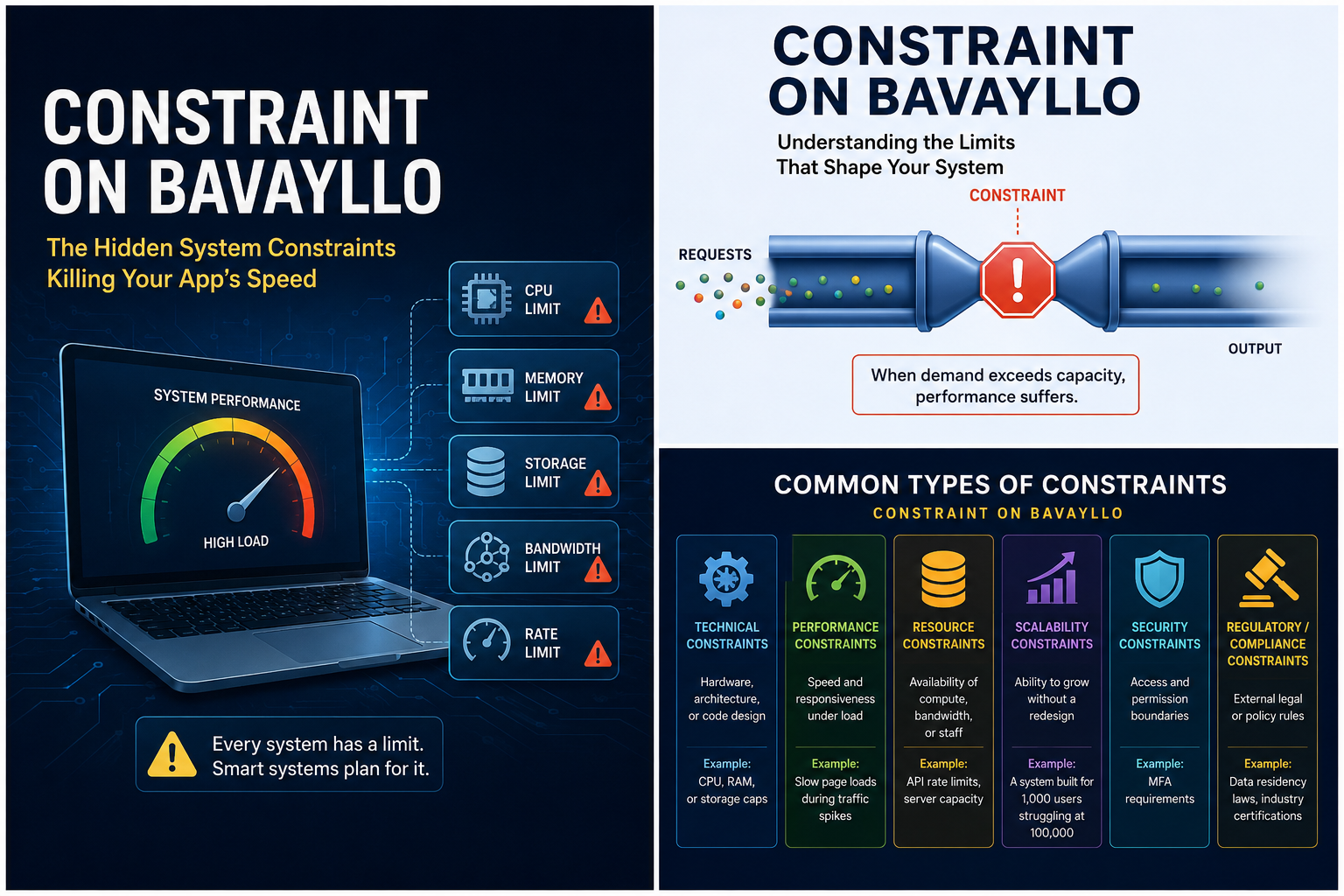
Think of a system as a network of pipes. Data, requests, and processes flow through it the way water flows through plumbing. Each pipe has a maximum throughput the amount it can carry per second. Push more through than it can handle, and pressure builds, flow slows, and everything downstream feels the strain.
That’s the essence of a constraint: not a break in the system, but a capacity limit that, once reached, changes how the whole system behaves.
Types of Constraints in Digital Systems

Constraints generally fall into a handful of recognizable categories.
| Constraint Type | What It Limits | Common Example |
| Technical constraints | Hardware, architecture, or code design | CPU, RAM, or storage caps |
| Performance constraints | Speed and responsiveness under load | Slow page loads during traffic spikes |
| Resource constraints | Availability of compute, bandwidth, or staff | API rate limits, server capacity |
| Scalability constraints | Ability to grow without a redesign | A system built for 1,000 users struggling at 100,000 |
| Regulatory/compliance constraints | External legal or policy rules | Data residency laws, industry certifications |
| Security constraints | Access and permission boundaries | Multi-factor authentication requirements |
Structural vs. Operational Constraints
It helps to separate constraints into two broader buckets:
- Structural constraints are built into the system’s design and rarely change without a redevelopment effort.
- Operational constraints emerge from day-to-day usage configuration choices, integrations, and how heavily the system is used.
Common Causes of Constraints
Constraints don’t appear at random. A few underlying causes show up again and again:
- Limited resources memory, processing power, or bandwidth reaching capacity
- Legacy design assumptions a system built for a smaller scale than it now handles
- Configuration drift small settings changes over time that quietly introduce new limits
- Third-party dependencies external APIs or services imposing their own rate limits or downtime
- Poor monitoring problems that go unnoticed until they become serious
- Growth outpacing infrastructure demand increasing faster than capacity planning accounted for
How Constraints Affect Performance and Outcomes
Because most systems are interconnected, a limit in one area rarely stays isolated. This is often called the ripple effect: pressure in one layer pushes into the next, and the end user feels it as slowness, errors, or failed actions.
Typical effects include:
- Slower response times as the system nears its limit
- Increased error rates or dropped requests
- Higher operating costs from workarounds and emergency scaling
- Frustrated users and reduced trust in the platform
- Stalled growth, since new features or users can’t be added safely
Real-World Examples of Constraints
- E-commerce sites during major sales events (like Black Friday) often hit server and database constraints, causing checkout failures under heavy concurrent traffic.
- Cloud storage services cap free-tier accounts at a fixed number of gigabytes — a straightforward resource constraint.
- APIs frequently enforce rate limits (for example, a fixed number of requests per minute) to protect shared infrastructure.
- Mobile apps on older devices run into hardware constraints, where limited RAM or an outdated processor caps how smoothly the app runs regardless of network speed.
How to Identify Constraints
Spotting a constraint early is far easier than fixing it after it causes an outage. Watch for:
- Gradual slowdowns that worsen under higher load
- Repeated errors tied to a specific feature or process
- Features that silently fail without a clear error message
- Spikes in resource usage (CPU, memory, storage) that correlate with slow performance
Practical steps to diagnose a constraint:
- Check system logs and monitoring dashboards for load spikes
- Isolate which component slows first under stress testing
- Compare current usage against original capacity planning
- Review recent configuration or dependency changes
Effective Strategies to Solve and Reduce Constraints
| Strategy | Why It Helps |
| Asynchronous processing | Reduces the chain of tasks waiting on each other |
| Caching | Cuts down repeated requests for the same data |
| Load balancing | Distributes demand across multiple servers |
| Horizontal scaling | Adds capacity without redesigning the whole system |
| Regular architecture reviews | Catches constraints before they become critical |
| Proactive monitoring and alerts | Flags problems before users notice them |
It’s also worth remembering: more hardware doesn’t fix every constraint. Some limits are logic built into how software processes requests, not physical, so throwing resources at the problem without addressing the root cause often just delays the next bottleneck.
Best Practices to Avoid Future Constraints
- Design with headroom build in buffer capacity rather than running at the edge of current demand
- Set up monitoring that alerts before a critical threshold is hit, not after
- Review architecture on a regular schedule as usage grows
- Avoid patching the same weak point repeatedly without checking the broader system design
- Document capacity assumptions so teams know when a redesign, not a patch, is needed
Future Outlook: Constraints in Evolving Systems
As systems increasingly rely on cloud infrastructure, AI-driven automation, and global user bases, constraints are shifting rather than disappearing. Predictive monitoring, auto-scaling infrastructure, and AI-assisted capacity planning are helping teams catch limits earlier. But constraints will never vanish entirely; every system, no matter how advanced, will always have a ceiling somewhere. The advantage goes to teams that plan for that reality instead of being surprised by it.
FAQs
What is a system constraint in simple terms?
A system constraint is any limit technical, resource-based, or policy-driven that controls how a system performs or scales.
Are constraints always bad?
No. Many constraints, like security limits or rate caps, exist to protect stability and prevent overload.
What’s the difference between a constraint and a system failure?
A failure means something is broken; a constraint means the system still works but is limited in speed, capacity, or flexibility.
Can constraints be completely removed?
Not entirely. Some limits are structural and permanent, but their impact can usually be reduced through better design, monitoring, and resource planning.
Conclusion
Constraint on bavayllo are a normal, unavoidable part of any digital system, not a sign that something is broken. Understanding the type of constraint you’re facing, what’s causing it, and how it ripples through the rest of the system turns a vague performance problem into something you can actually fix. The goal isn’t to eliminate every limit; it’s to recognize which ones protect stability and which ones are simply holding back growth.