
Learning machine learning can feel confusing at first, but this guide turns it into a clear, step-by-step path. This roadmap answers how to learn machine learning in the simplest way possible. Here is how to learn machine learning from zero: the machine learning basics, Python, the small amount of math you really need, the core workflow, free courses, and your first real project — all explained in plain English for complete beginners.
Last updated: November 2026.
Machine learning sounds like something only programmers and math experts can do. That is no longer true. A complete beginner with a laptop and a few hours a week can learn the basics, build a first project, and understand how the AI tools around them actually work.
This guide shows you how to learn machine learning step by step: what to learn first, in what order, which free resources to use, and how to avoid the most common beginner mistakes.
You do not need a math degree, an expensive course, or a powerful computer. You need a plan, a little patience, and one finished project. This roadmap gives you all three.
If you have ever wondered how to learn machine learning without a computer science degree, this roadmap is for you.
What Is Machine Learning, in Simple Words?
Machine learning is a way of teaching computers from examples instead of giving them fixed rules.
With normal programming, you write every rule yourself: “if the email contains this word, mark it as spam.” With machine learning, you show the computer thousands of examples of spam and not-spam emails, and it learns the patterns on its own. This is the same basic idea behind the neural networks explained in our guide to what a neural network is.
A useful way to think about it: a child does not learn to recognise a dog from a textbook definition. They see many dogs and slowly understand what makes a dog a dog. Machine learning works the same way, with data instead of pictures in a book.
The key word is examples. Machine learning runs on training data — collections of examples the model learns from. The better the examples, the better the model.
Machine Learning vs AI vs Deep Learning
These three terms get mixed up a lot, so here is the simple version.
Artificial intelligence (AI) is the broad field: any system that does a task that normally needs human thinking. Machine learning is one approach inside AI: instead of writing fixed rules, you let the system learn patterns from data. Deep learning is one type of machine learning: it uses neural networks with many layers, which is why it is good at images, speech, and language.
Think of it this way: AI is the whole subject, machine learning is one chapter of it, and deep learning is one page in that chapter. You do not need deep learning to start. You need the basics in this roadmap first — the workflow, the data, and one finished project. Deep learning comes later, when the basics feel comfortable.
If the words still blur together, our guide to the different types of AI explains each type with simple real-world examples.
Supervised vs Unsupervised Learning: The Two Main Ways Machines Learn
Most beginner machine learning falls into two types. Knowing the difference early saves a lot of confusion.
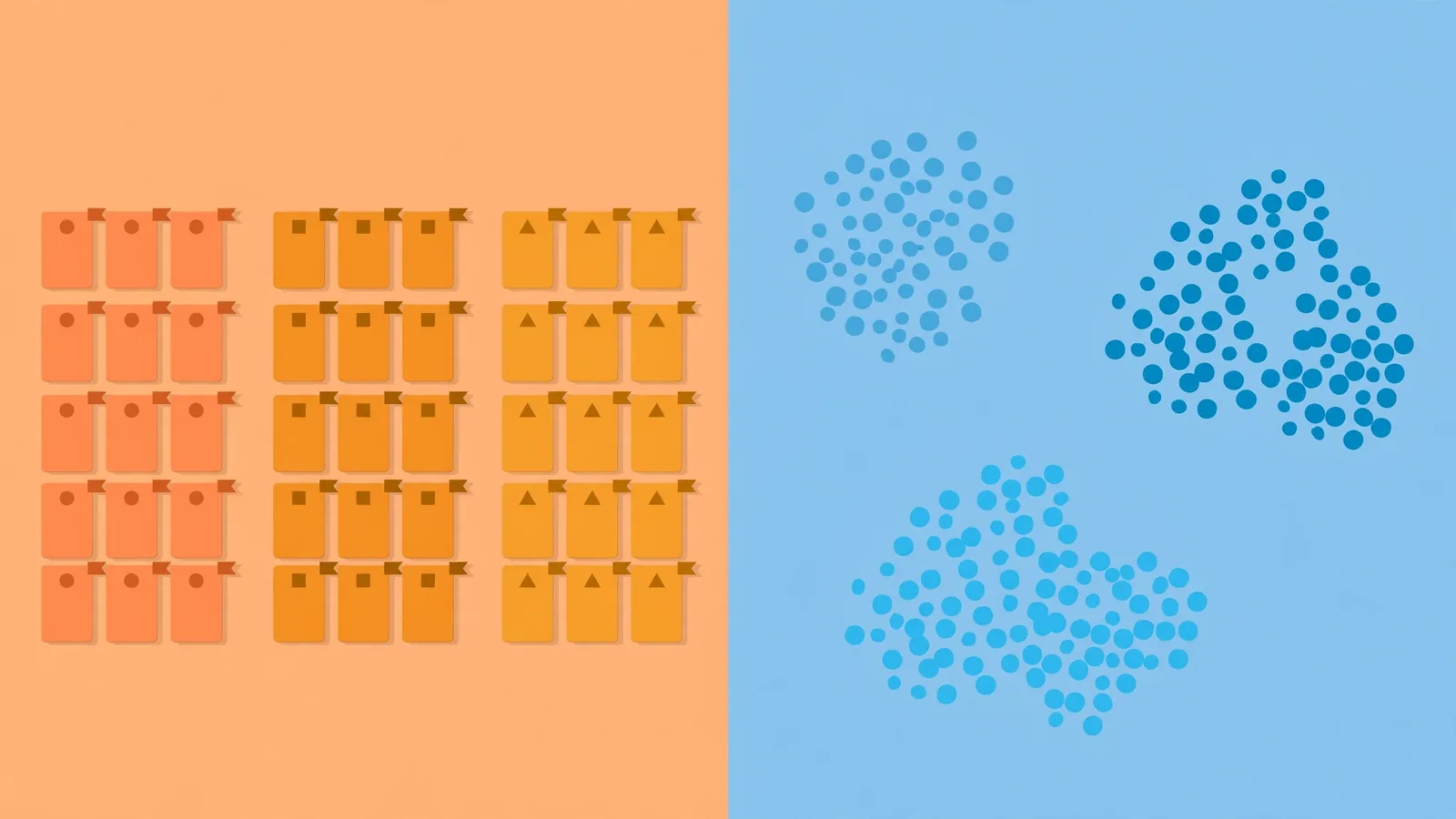
Supervised learning means the model learns from labeled examples — every example comes with the correct answer attached. You show it thousands of emails marked “spam” or “not spam”, and it learns to tell them apart. Predicting a house price from its size and location works the same way: every past sale in the training data has a known price. Supervised learning is where most beginners start, because you can check whether the model is right.
Unsupervised learning means the data has no labels and no correct answers. The model finds patterns on its own. A shop might use it to group customers by buying habits, or a bank might use it to spot transactions that look unusual. There is no single right answer to check against, so judging the result takes more experience.
| Type | What the data looks like | Beginner example |
|---|---|---|
| Supervised learning | Labeled examples, with the correct answer attached | Spam or not spam; house price prediction |
| Unsupervised learning | No labels, no correct answers given | Grouping customers; spotting unusual transactions |
You will meet both types again in Step 3, because the workflow is the same either way — the difference is only in the data you start with.
Best Way to Learn Machine Learning
Here is the order that works for most beginners. Do not skip steps, and do not try to learn everything at once.
Step 1: Learn the Basics of Programming (Python)
Almost all beginner machine learning uses Python, because it is readable and has powerful free tools. You do not need to become a software engineer. You need:
- Basic Python: variables, lists, loops, functions, and reading files
- How to install and run Python (free from the official site: python.org)
- The idea of a “library” — ready-made code other people wrote that you can use
The two Python libraries you will meet most are pandas, for working with data, and scikit-learn, for building models. You do not need to learn them all at once — meet each one when the roadmap reaches it.
A good free starting point is the Python sections of freeCodeCamp or the official Python tutorial. Aim for comfort with small scripts, not perfection.
Step 2: Learn a Little Math — Only What You Need
Machine learning uses math, but beginners need far less than they fear. Focus on three areas:
- Statistics basics: averages, probability, and what a dataset looks like. This connects directly to how datasets work in AI
- Linear algebra intuition: what vectors and matrices are, at a “what does this picture mean” level.
- Calculus intuition: the idea of a slope and how a model improves by following it downhill — no need to solve integrals by hand.
You can learn these alongside programming, in small doses, as each topic comes up.
Step 3: Learn the Core Machine Learning Workflow
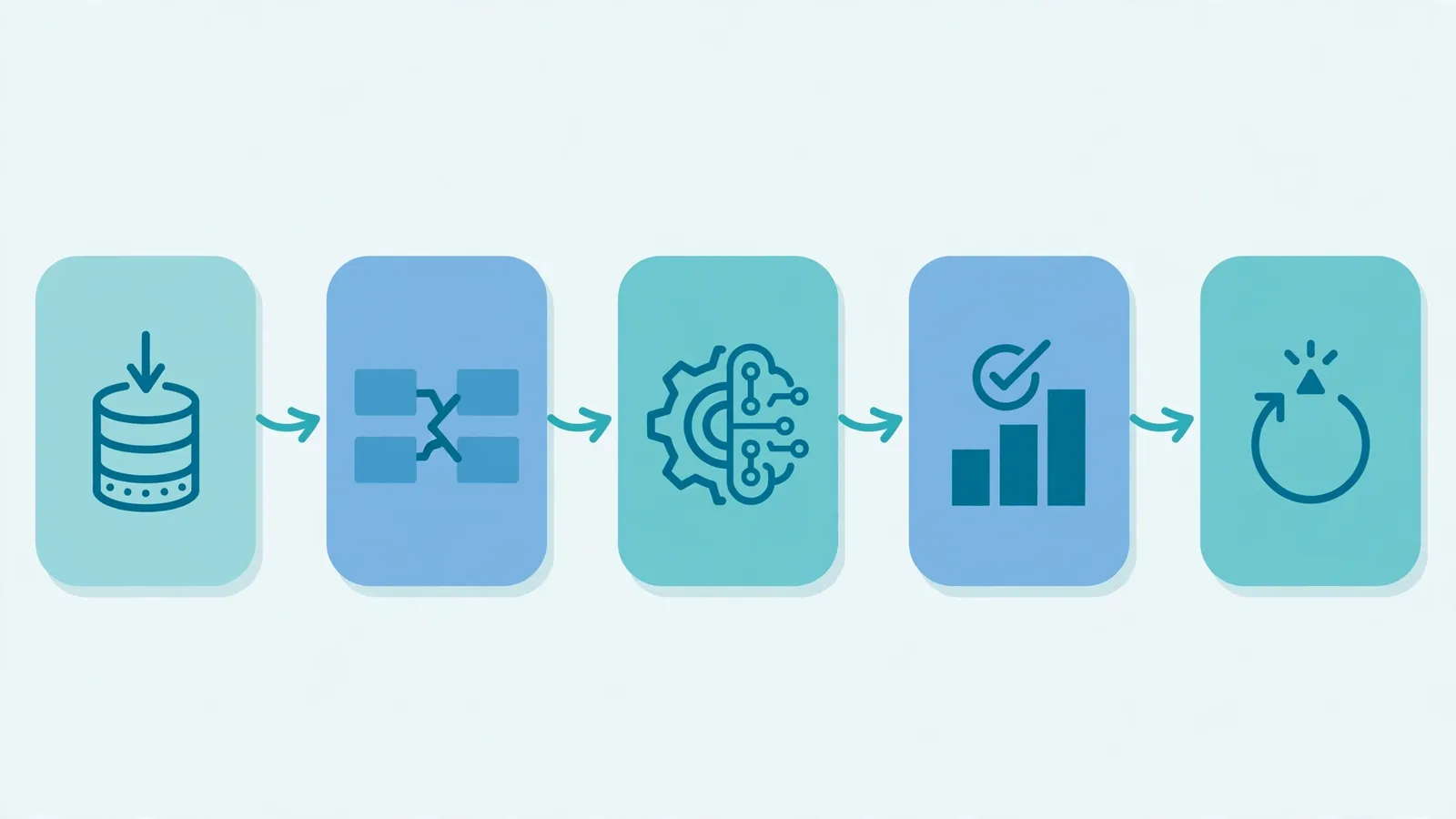
This is the heart of the roadmap — the five steps at the center of how to learn machine learning. Every project, from spam filters to recommendation systems, follows the same five steps:
- Collect and clean data — gather examples and fix errors in them.
- Split the data — keep some examples hidden, so you can test whether the model truly learned or just memorised.
- Train a model — let an algorithm learn patterns from the training data.
- Evaluate it — check the model’s accuracy on the hidden data.
- Improve it — adjust and repeat.
Two ideas matter most in model evaluation: accuracy and overfitting. Accuracy is simply how often the model is right on data it has never seen. Overfitting is what happens when a model memorises the training data so well that it fails on new data — a model that scores 100% on training data but poorly on the hidden test data has not really learned anything. This is why step 2 in the list above (splitting the data) exists: the hidden test set is the only honest check.
Start with two beginner-friendly model types: linear regression (predicting a number, like a house price) and classification (putting things into categories, like spam or not-spam). The main free tool for both is scikit-learn, which works directly with Python.
Step 4: Build a First Project
Reading about machine learning is not the same as doing it. Your first project should be small, complete, and real:
- Predict house prices from a simple dataset, or
- Classify whether an email is spam, or
- Predict if a customer will churn (leave) based on simple features.
Use a free data set from Kaggle, which hosts thousands of public data sets, or the built-in data sets in scikit-learn. The goal is not a perfect model. The goal is finishing the full workflow once, end to end, so the process becomes familiar.
A good first project has four things: a free data set you can download in minutes, a clear question (predict a number, or sort things into groups), one simple model (linear regression or a decision tree), and a short write-up of what worked and what did not. Keep it small. A finished small project teaches you more than a big unfinished one.

Step 5: Practice a Little Every Day
Practice a little every day. One focused hour a day, a short exercise, or a small improvement to your project is enough. Daily practice is what turns the first four steps into real skill.
What to Learn After the Basics
Once your first project is done, you have the foundation — and a real answer to how to learn machine learning. Here is what usually comes next, in order:
- A second project with a different data set, so the workflow becomes habit instead of a one-time exercise.
- One more algorithm, like decision trees or random forests, so you can compare models instead of using the same one every time.
- Deep learning basics — neural networks with many layers — but only when the basics feel comfortable. Deep learning is powerful, and it is also the easiest place to get lost as a beginner.
- A short write-up of your project: what the data was, what you tried, and what you learned. Explaining your work is one of the fastest ways to understand it.
Generative AI — the tools that write text and create images — builds on everything in this roadmap. Our guide to generative AI tasks and examples for beginners shows which everyday tasks these tools can actually do, and which they cannot.
A Realistic Timeline: What to Expect
Here is a realistic timeline for how to learn machine learning, one focused hour a day.
- Weeks 1–4: Python basics and comfort reading simple code.
- Weeks 5–8: Statistics intuition and your first scikit-learn models.
- Weeks 9–12: One complete project, plus understanding overfitting, training vs. testing, and basic evaluation metrics.
- Months 4–6: A second project with a different data set, and your first look at deep learning.
One focused hour a day beats a weekend binge followed by nothing. Consistency matters more than intensity — that is the real secret of how to learn machine learning.
Free Resources That Actually Work
- freeCodeCamp — free Python and machine learning courses with certificates. (freecodecamp.org)
- Kaggle Learn — short, practical, free micro-courses, including the exact workflow in Step 3. (kaggle.com/learn)
- Google’s Machine Learning Crash Course — free, beginner-friendly, with interactive exercises. (developers.google.com/machine-learning/crash-course)
- Andrew Ng’s Machine Learning Specialization (Coursera) — the most recommended beginner course. It is a paid specialization (around $49 a month) with a 7-day free trial — check the current price and the financial-aid options on Coursera before you enroll. (coursera.org/specializations/machine-learning-introduction)
- StatQuest (YouTube) — the best free channel for math and ML intuition in plain English. (youtube.com/channel/UCtYLUTtgS3k1Fg4y5tAhLbw)
- scikit-learn documentation — the official docs and examples for the library you will use in Step 3. (scikit-learn.org)
Start with one. Finishing one course beats collecting five — that is how to learn machine learning without getting overwhelmed.
5 Beginner Mistakes to Avoid
- Starting with deep learning. Neural networks are exciting, but they are the advanced topic, not the starting point. Understand the basic workflow first — our article on how neural networks learn shows why the foundations matter.
- Tutorial hell. Watching course after course without building anything. Build after every small lesson.
- Skipping data cleaning. Real beginners’ models fail mostly on messy data, not on algorithms.
- Chasing perfect accuracy. A simple model you understand beats a complex one you copied.
- Learning math for months before touching code. Learn math in small pieces, attached to real problems.
Where Machine Learning Fits in the Bigger AI Picture
Machine learning is one part of artificial intelligence — the part where systems learn from data. It sits alongside other approaches, like rule-based systems and search. And it powers the automated workflows in our guide to what intelligent automation is, where learned models are combined with automation to do real work.
If you want the bigger picture — why AI was built in the first place and what it is for — read our guide on the purpose of AI.
If you are completely new to AI, start with the pillar guide: Artificial Intelligence: A Helpful 2026 Guide
If you are still deciding how to learn machine learning, start with the basics in this roadmap — the rest follows from there.
Frequently Asked Questions
Do I need a math degree to learn machine learning?
No. You need basic statistics and algebra intuition, learned gradually. A degree helps for research careers, not for learning the fundamentals or building first projects.
How long does it take to learn machine learning?
With one focused hour a day, most beginners can complete a first real project in about three months. Comfortable working knowledge takes longer, but the roadmap above is enough to start.
Which language should I learn first?
Python. It is the standard language for beginner machine learning, and its main libraries (scikit-learn, pandas) are free.
Is machine learning the same as AI?
No. Machine learning is one approach within AI — the approach where systems learn patterns from data. AI also includes other methods, like rule-based systems and search. See our guide on the purpose of AI for the full picture.
Can I learn machine learning for free?
Yes. Every resource listed above has a free option, and all the software (Python, scikit-learn, Kaggle datasets) is free.
What is the difference between supervised and unsupervised learning?
In supervised learning, the model learns from labeled examples — every example comes with the correct answer, like emails marked spam or not spam. In unsupervised learning, the data has no labels, and the model finds patterns on its own, like grouping similar customers together. Most beginners start with supervised learning because it is easier to check the results.
How do I stay updated with new machine learning developments?
Learn the basics first, then follow reliable sources. Our guide to the latest AI news explains how to find trustworthy updates and check a headline before you believe it.
Can you learn machine learning on your own?
Yes. With daily practice, free courses, and small projects, you can learn machine learning on your own. Start with Python basics, follow the core workflow, and build one small project at a time, you do not need a classroom or a degree to begin.
Conclusion
Learning machine learning is a sequence, not a mystery. That is the whole answer to how to learn machine learning: Python basics, a little math intuition, the core workflow, and one finished project. Follow the roadmap in order, build something small and real, and you will understand more in three months than most people who only read about AI.
Start today with Step 1 — and when you finish your first project, you will know exactly what to learn next.
Related reading: Python for AI: A Beginner’s Guide





3 Comments