
What Makes Neural Networks Learn? A Step-by-Step Guide
Neural networks learn by analyzing examples, identifying patterns, measuring their mistakes, and adjusting internal parameters to improve future predictions. This process is a foundation of artificial intelligence, machine learning, and deep learning. Understanding how neural networks learn helps beginners explore artificial neural networks, biological neural networks, and practical applications such as image recognition, recommendation systems, and generative AI. In this guide, we will break down the seven essential steps behind neural network learning using simple explanations and real-world examples.
Last updated: November 2026.
Understanding How Neural Networks Learn
Artificial intelligence has changed how computers process information and solve problems. From recognizing faces in photographs to understanding spoken questions, modern AI systems can perform tasks that once required significant human effort.
One of the technologies behind these capabilities is the artificial neural network.
But how does a computer learn to recognize a cat, identify spam emails, or predict whether a customer might purchase a product?
Traditional computer programs generally follow instructions written by developers. Neural networks work differently. Instead of requiring programmers to define every possible rule, developers provide data and a learning process that allows the network to discover useful patterns.
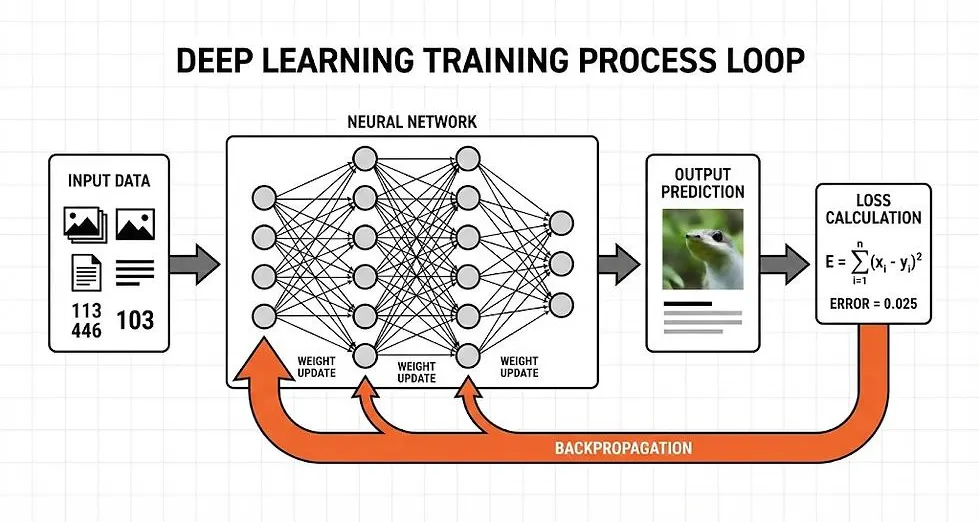
The network starts with adjustable mathematical values. During training, it processes examples, generates predictions, measures errors, and updates those values. After repeating this process, it can become better at recognizing patterns in new information.
Let’s explore the seven steps that explain how neural networks learn.
1. Understanding What is a Neural Network ?
Before exploring the learning process, it is important to understand what a neural network actually does.
An artificial neural network is a machine learning model made up of interconnected computational units commonly called neurons or nodes. These neurons are organized into layers and work together to transform input information into an output.

The basic structure usually includes three main components:
- Input layer: Receives information that the network needs to process.
- Hidden layers: Perform calculations and help identify patterns in the input data.
- Output layer: Produces the final prediction or result.
Each connection between neurons has a numerical value called a weight. Neurons also use values called biases, which help adjust their calculations.
An activation function determines how a neuron transforms its calculated input before passing information to the next layer.
For example, imagine a neural network designed to recognize handwritten numbers. The input layer receives an image containing a handwritten digit. Hidden layers process visual patterns such as lines, curves, and shapes. Finally, the output layer estimates which number appears in the image.
The network does not automatically understand what a number means. It learns mathematical patterns that help it distinguish one digit from another.
What Is a Neural Network in AI?
In artificial intelligence, a neural network is a model that learns relationships between inputs and outputs using examples.
It can help AI systems perform tasks such as:
- Recognizing objects in images.
- Understanding human language.
- Detecting unusual financial transactions.
- Predicting future demand.
- Recognizing speech.
- Generating text and other content.
Neural networks are especially useful when the relationship between information and the desired result is too complicated to describe using a small set of manually written rules.
2. Collecting and Preparing Training Data
The second step is providing the neural network with useful data.
A neural network cannot learn a meaningful task without examples related to that task. The quality, quantity, and relevance of the training data can significantly influence the model’s performance.
Consider a network designed to recognize cats and dogs.
The training dataset might contain thousands of animal photographs. Each photograph is converted into numerical information that the network can process.
For supervised learning, the examples also include labels identifying the correct category.
For example:
| Image | Correct label |
|---|---|
| Photograph of a cat | Cat |
| Photograph of a dog | Dog |
| Photograph of another cat | Cat |
| Photograph of another dog | Dog |
The model receives the image as input and attempts to predict its category.
However, real-world datasets are not always ready for training. They may contain duplicate records, incorrect labels, missing information, inconsistent formats, or irrelevant details.
If you are new to this, our guide to what a data set is in AI explains what training data actually looks like, the main types of data sets, and how to clean one before you trust it.
Data preparation helps address these problems.
Common Data Preparation Activities
Data cleaning: Removing incorrect, duplicated, or incomplete records where appropriate.
Data labeling: Assigning meaningful categories or target values to examples when supervised learning requires them.
Normalization: Adjusting numerical values to suitable scales so that features with very different ranges do not create unnecessary training difficulties.
Feature preparation: Converting raw information into a format that the model can process.
Data splitting: Separating examples into training, validation, and testing datasets.
A common approach is to use training data to fit the model, validation data to help make development decisions, and testing data to evaluate performance on examples that were not used during training.
Good preparation matters because a model can learn incorrect patterns from poor-quality information.
3. Initializing Weights and Biases
Once the data is prepared, the network needs an initial set of parameters.
These parameters include weights and biases.
Weights determine how strongly information from one neuron influences another neuron. Biases provide additional adjustable values that influence a neuron’s calculation.
At the beginning of training, many neural networks use carefully designed random initialization methods to assign starting values to their trainable parameters.
Why not start with all weights set to zero?
If every neuron in the same layer starts with identical values, they may perform identical calculations and fail to develop different roles during learning. Appropriate initialization helps neurons begin with different parameter values.
A Simple Example
Imagine a network receiving two inputs:
- Hours spent studying.
- Number of practice questions completed.
It uses these inputs to predict whether a student will pass an examination.
The network assigns weights to both inputs. Initially, it does not know how important each feature should be.
During training, the weights are adjusted based on how well the network’s predictions match the expected results.
The important point is that the network does not begin with complete knowledge. Its initial parameters provide a starting point for the learning process.
4. Processing Information Through Forward Propagation
The fourth step is forward propagation.
Forward propagation occurs when information moves from the input layer through the hidden layers and reaches the output layer.
Each neuron receives numerical inputs, multiplies them by corresponding weights, adds a bias, and applies an activation function.
A simplified neuron calculation looks like this:
[
z = (x_1w_1 + x_2w_2) + b
]
Where:
- (x_1) and (x_2) represent input values.
- (w_1) and (w_2) represent connection weights.
- (b) represents the bias.
- (z) represents the weighted sum before activation.
The activation function transforms this value and produces the neuron’s output.
That output can then become an input for neurons in the next layer.
This process continues until the network produces its final prediction.
Neural Network Example: Recognizing a Cat
Imagine uploading a photograph of a cat to an image recognition model.
The network receives numerical representations of the image.
Its early layers may respond to simple visual patterns, such as edges and color changes. Deeper layers can combine information into more complex patterns, such as shapes, textures, and object features.
The final output might look like this:
| Prediction | Confidence score |
|---|---|
| Cat | 0.88 |
| Dog | 0.08 |
| Rabbit | 0.04 |
These values represent the model’s predicted probabilities in this simplified example.
The network predicts that the image contains a cat because that category receives the highest score.
However, producing a prediction does not automatically mean the network has learned the task correctly. It must compare its prediction with the correct answer.
5. Measuring Mistakes With a Loss Function
After forward propagation, the network needs a way to measure how accurate its prediction was.
This is where a loss function becomes important.
A loss function measures the difference between a model’s prediction and the expected result. Its value provides a numerical indication of how poorly or well the model performed on the examples being evaluated.
For example, imagine that the correct label for an image is Cat, but the network predicts Dog.
The prediction is incorrect, so the loss function assigns a penalty based on the model’s output and the chosen loss calculation.
During training, the objective is generally to reduce the loss across the training examples.
Common Loss Functions
Different tasks require different loss functions.
Mean Squared Error (MSE): Commonly used in regression tasks. It measures the average squared difference between predicted and actual numerical values.
Binary Cross-Entropy: Often used for classification problems involving two possible classes.
Categorical Cross-Entropy: Commonly used when a model chooses between multiple categories.
The loss function gives the training process a measurable objective.
Without a loss calculation, the network would have no clear mathematical signal indicating whether its predictions should improve.
Why Lower Loss Matters
Imagine a network predicting house prices.
Its first prediction for a particular house might be $250,000, while the actual price is $300,000.
The difference indicates that the prediction needs improvement.
After training on many examples, the network may adjust its parameters and produce more accurate predictions.
However, lower training loss does not always mean a model will perform well on new information. A model can memorize its training examples instead of learning patterns that generalize.
This problem is called overfitting, and it is one reason validation and testing are essential.
6. Improving Predictions Through Backpropagation
Backpropagation is one of the most important mechanisms used to train artificial neural networks.
After the loss function measures prediction errors, backpropagation calculates how the network’s trainable parameters contributed to that error.
It works by propagating gradient information backward through the network.
In simple terms, it helps determine how changing individual weights and biases would affect the loss.
The process uses the chain rule from calculus to calculate gradients efficiently.
These gradients indicate how sensitive the loss is to changes in different parameters.
How Backpropagation Works
The process can be understood through four activities:
- The network generates a prediction through forward propagation.
- The loss function measures the prediction error.
- Backpropagation calculates gradients for the trainable parameters.
- An optimizer uses those gradients to update the parameters.
It is important to understand that backpropagation calculates the gradients. The optimizer performs the parameter updates.
These two activities work together during neural network training.
Understanding the Process With an Example
Imagine a neural network predicting whether an email is spam.
It receives information such as:
- Words appearing in the email.
- The number of links.
- Sender information.
- Other useful message features.
The model predicts that the email has a 40% probability of being spam.
However, the correct training label indicates that it is spam.
The network’s prediction is not sufficiently accurate.
Backpropagation calculates how the network’s parameters contributed to the loss. The optimizer then uses this information to adjust the weights and biases.
After many training examples and updates, the model may become better at identifying patterns associated with spam emails.
Backpropagation does not mean the network thinks about its mistakes like a human. It is a mathematical process for calculating gradients.
7. Updating Weights, Repeating Training, and Testing Results
The final step combines parameter updates, repeated training, and performance evaluation.
After backpropagation calculates gradients, an optimization algorithm adjusts the network’s trainable parameters.
One commonly used optimization method is gradient descent.
Gradient descent updates parameters in a direction intended to reduce the loss.
A simplified weight update equation is:
[
w_{\text{new}} = w_{\text{old}} – \eta \frac{\partial L}{\partial w}
]
Where:
- (w_{\text{new}}) is the updated weight.
- (w_{\text{old}}) is the previous weight.
- (\eta) is the learning rate.
- (L) represents the loss function.
- The derivative represents the gradient of loss with respect to the weight.
What Is a Learning Rate?
The learning rate controls the size of parameter updates.
A learning rate that is too high can cause unstable training or make the optimization process overshoot useful parameter values.
A learning rate that is too low can make training unnecessarily slow.
Choosing an appropriate learning rate is therefore an important part of model development.
What Is an Epoch?
An epoch represents one complete pass through the training dataset.
A neural network generally needs multiple epochs to improve its predictions.
For example:
- Epoch 1: The network begins learning basic patterns.
- Epoch 2: The network receives another opportunity to adjust its parameters.
- Epoch 3: The network continues reducing prediction errors.
- Later epochs: The network may continue improving, depending on the data and training setup.
Training continues until a stopping condition is reached.
That condition may involve a maximum number of epochs, a training objective, or validation performance that stops improving.
Testing Whether the Network Has Actually Learned
A neural network should not be evaluated only on the examples it used during training.
Developers use separate testing data to understand how well the model handles previously unseen examples.
For classification tasks, common evaluation measures include:
- Accuracy.
- Precision.
- Recall.
- F1 score.
- Confusion matrix.
For regression tasks, developers may use measures such as mean absolute error and mean squared error.
Testing helps reveal whether the network has learned useful patterns or simply memorized the training dataset.
A successful model should perform reasonably well on relevant new examples, not only on its original training data.
What Is a Neural Network in the Brain?
The idea of artificial neural networks was inspired by biological neural networks found in the human brain and nervous system.
The human brain contains billions of neurons that communicate through complex biological processes.
Biological neurons receive signals through structures such as dendrites, process information in the cell body, and transmit signals through axons. Connections between neurons are called synapses.
These biological systems support learning, memory, perception, and many other functions.
Artificial neural networks borrow the general idea of interconnected processing units, but they are not exact copies of the human brain.
| Biological neural network | Artificial neural network |
|---|---|
| Made of biological neurons | Made of mathematical computational units |
| Uses electrochemical signals | Uses numerical calculations |
| Communicates through synapses | Uses weighted connections |
| Learns through biological changes | Learns by adjusting parameters |
| Operates inside living nervous systems | Runs on computing hardware |
This distinction is important.
When people say that an artificial neural network works like the human brain, they are describing a simplified inspiration rather than claiming that modern AI models reproduce the brain’s complete biological functioning.
How Neural Networks Learn in Different Types of Machine Learning
Neural networks can be trained using different learning approaches. The method depends on the task, the available data, and the desired outcome.
Supervised Learning
Supervised learning uses labeled examples.
The network receives an input and an expected output. It makes predictions, calculates errors, and adjusts its parameters to improve future predictions.
For example, a model trained to identify cats and dogs receives labeled photographs.
This approach is useful for classification and regression tasks.
Unsupervised Learning
Unsupervised learning works with data that does not have predefined labels for the desired output.
The objective is to discover patterns, relationships, or structures within the data.
For example, a model may help identify groups of customers with similar purchasing behavior.
Some neural network architectures are designed for tasks such as representation learning and clustering.
Self-Supervised Learning
Self-supervised learning allows a model to create training signals from the data itself.
For example, a language model may learn by predicting missing or next tokens in text.
This approach has become particularly important in modern AI because it allows models to learn from large collections of information without requiring every example to be manually labeled.
Reinforcement Learning
In reinforcement learning, an agent interacts with an environment and receives rewards or penalties based on its actions.
A learning system can use these signals to improve its decision-making strategy.
Neural networks can be used as part of reinforcement learning systems, including models that estimate values or select actions.
What Is a Neural Network Used For?
Neural networks are used in many industries because they can identify complex patterns in large datasets.
Here are some important applications.
1. Image Recognition
Neural networks help computers identify objects, people, and visual features in images.
They are used in photo organization, manufacturing inspection, medical imaging, and security-related applications.
2. Natural Language Processing
Neural networks help computers process human language.
They support applications such as translation, text classification, sentiment analysis, summarization, and conversational AI.
3. Speech Recognition
Speech recognition systems use neural networks to convert spoken language into text.
Virtual assistants, transcription tools, and voice-controlled applications rely on this technology.
4. Healthcare
Neural networks can help analyze medical images, identify patterns in health-related datasets, and support certain prediction tasks.
They are tools for assisting qualified professionals, not automatic replacements for medical judgment.
5. Finance
Financial organizations use machine learning models for tasks such as fraud detection, risk analysis, and forecasting.
Neural networks can identify complex patterns that may be difficult to capture using simple rules.
6. Recommendation Systems
Streaming platforms, online stores, and content services use machine learning to identify user preferences.
Neural network models can help estimate which products, videos, or other content a person may find relevant.
7. Generative AI
Modern generative AI systems use neural network architectures to generate text, images, audio, and other types of AI content.
Large language models, for example, use neural networks to learn statistical relationships in language and generate responses based on context.
Can Beginners Learn Neural Networks for Free?

Yes. Beginners can learn neural networks without immediately purchasing expensive courses or software.
A good starting point is to understand the basic concepts before attempting to build complicated models.
Step 1: Learn Basic Mathematics
Start with the fundamentals of:
- Algebra.
- Functions.
- Basic probability.
- Statistics.
- Vectors and matrices.
- Introductory calculus.
You do not need to master advanced mathematics before exploring the basic ideas behind neural networks.
Step 2: Learn Python Programming
Python is widely used in machine learning because it has a large ecosystem of libraries and learning resources.
Focus on:
- Variables and data types.
- Lists and dictionaries.
- Functions.
- Loops.
- Basic file handling.
- NumPy and data manipulation.
Step 3: Understand Machine Learning Fundamentals
Learn how datasets, features, labels, training, validation, and testing work.
Understanding these concepts will make neural network training easier to follow.
Step 4: Explore Neural Network Libraries
Beginners can experiment with popular tools such as:
- TensorFlow.
- Keras.
- PyTorch.
- Scikit-learn.
These libraries provide tools for creating, training, and evaluating machine learning models.
Step 5: Practice With Small Projects
Start with simple projects such as:
- Handwritten digit recognition.
- Email spam classification.
- Basic image classification.
- House price prediction.
- Customer grouping.
Practical experience helps connect mathematical concepts with real applications.
Where Can You Find Free Neural Network Learning Resources?
Several online resources provide educational material for beginners.
Google’s Machine Learning Crash Course includes lessons on neural networks and backpropagation. Official documentation for TensorFlow and PyTorch also provides tutorials and practical examples.
GitHub can be useful for exploring open-source neural network projects, example notebooks, and Python implementations.
When using GitHub, beginners should check project documentation, installation instructions, code quality, and maintenance activity before relying on a repository.
A useful learning strategy is to understand a small example first, run the code, change a few parameters, and observe how the results change.
Why Do Neural Networks Sometimes Make Mistakes?
Although neural networks can perform impressive tasks, they are not perfect.
Their performance depends on several factors.
Poor-Quality Training Data
If training data contains incorrect labels, missing information, or unrepresentative examples, the model may learn unreliable patterns.
Overfitting
Overfitting happens when a model performs very well on training data but struggles with new examples.
It may memorize details instead of learning general patterns.
Underfitting
Underfitting occurs when a model is too simple or insufficiently trained to capture important relationships in the data.
Bias in Training Data
If the dataset does not represent different real-world situations fairly, the model may produce uneven or unreliable results.
High Computational Requirements
Large neural networks may require powerful hardware, significant memory, and long training times.
Developers must balance model size, performance, cost, and practical requirements.
Understanding these limitations is essential when developing or using AI systems.
The Future of Neural Network Learning
Neural networks continue to influence the development of artificial intelligence.
Research is improving how models process information, learn from examples, use computing resources, and handle complex tasks.
Several areas are particularly important.
More efficient training: Researchers are exploring methods to reduce the computing resources and time required to train models.
Transfer learning: Developers can adapt previously trained models to new tasks instead of always starting from the beginning.
Multimodal AI: Modern models increasingly work with combinations of text, images, audio, and video.
Explainable AI: Researchers are developing methods to better understand how models produce their predictions.
Responsible AI: Data quality, privacy, fairness, safety, and transparency are becoming important considerations in AI development.
These developments show why understanding neural network learning is useful for students, developers, researchers, and technology professionals.
In business, these trained networks often end up inside automated workflows. Our guide to intelligent automation shows seven real examples — invoice processing, customer support, and more — where neural networks do the reading and deciding.
Frequently Asked Questions
1. How do neural networks learn?
Neural networks learn by processing training examples, making predictions, measuring errors, calculating gradients through backpropagation, and adjusting their weights and biases. Repeating this process helps improve their performance on the task.
2. What is a neural network in simple words?
A neural network is a computer model made of connected mathematical units that learn patterns from data. It uses those patterns to make predictions, classify information, or generate outputs.
3. What is an example of a neural network?
An image recognition model is a common example. It can analyze a photograph and predict whether it contains a cat, dog, car, or another object.
4. Do neural networks learn like the human brain?
Artificial neural networks are inspired by biological neural networks, but they do not learn in exactly the same way as the human brain. Artificial models use mathematical operations and parameter updates, while biological brains rely on complex electrochemical processes.
5. What is backpropagation in neural networks?
Backpropagation is a method that calculates gradients showing how network parameters contribute to prediction errors. An optimization algorithm uses those gradients to update the parameters and reduce loss.
6. Can I learn neural networks without coding?
Yes. You can begin by studying concepts such as neurons, layers, weights, activation functions, and backpropagation without writing code. However, learning Python and practicing with machine learning libraries will help you understand how neural networks are built and trained.
7. Can beginners learn neural networks for free?
Yes. Beginners can use free educational resources, documentation, tutorials, and open-source projects. Google’s Machine Learning Crash Course and the official TensorFlow and PyTorch learning materials are useful starting points.
8. What is the difference between machine learning and neural networks?
Machine learning is a broad field that includes different methods for learning patterns from data. Neural networks are one type of machine learning model that uses interconnected computational units and adjustable parameters.
9. What is the difference between a neural network and deep learning?
Deep learning is a branch of machine learning that uses neural networks with multiple layers to learn complex patterns. Neural networks can have different depths, while deep learning specifically focuses on deeper network architectures.
10. What happens when a neural network is trained for too long?
Training for too long can cause overfitting, especially when the model starts memorizing training examples instead of learning patterns that generalize. Validation data helps developers identify when additional training is no longer improving performance.
11. Where can I read the news about new neural network research?
New models and results appear almost every week. Our guide to the latest AI news explains how to find reliable updates, check the original source, and tell a real breakthrough from a hyped headline.
Conclusion
Neural networks learn through a repeated mathematical process involving data, predictions, error measurement, and parameter updates. They begin with initial weights and biases, process information through forward propagation, measure mistakes using a loss function, and calculate gradients through backpropagation. An optimizer then updates the parameters so the model can improve over repeated training cycles.
Understanding these seven steps makes artificial intelligence and machine learning easier to explore. Whether you are interested in image recognition, generative AI, healthcare, finance, or Python programming, learning how neural networks work provides a strong foundation for understanding modern technology.
The best way to build that foundation is to start with simple concepts, explore small examples, and gradually move toward practical projects.
Related reading: What Is a Neural Network?, What Is a Data Set in AI? A Beginner’s Guide, and What Is the Purpose of AI?
Related reading: Intelligent Automation: 7 Easy AI Examples for Beginners and Latest AI News.







6 Comments