

Linux gaming has quietly crossed a turning point. The gap between Windows and Linux performance is no longer about the operating system it’s about knowing the right Linux gaming optimizations that most guides never actually explain.
Tech hacks PBLinuxGaming brings together the community-tested tweaks that move the needle: Proton compatibility tuning, CPU governor configuration, GPU driver settings, and kernel-level adjustments that together close the FPS gap for real. According to Valve’s 2024 Steam Survey, Linux gaming nearly doubled its user share since the Steam Deck launch. That growth means the knowledge base has matured fast. This guide puts it in one place.
Tech Hacks PBLinuxGaming: How to Actually Boost Linux Gaming Performance in 2026
This guide covers mid-range to high-end desktop and laptop Linux setups running Steam via Proton. It does NOT address console emulation, Wine-only workflows, or ARM-based hardware.
Linux gaming works better than it did two years ago. But “works” and “performs” are two different things, and if you’ve been staring at benchmark comparisons between your Arch setup and a Windows machine running the same GPU, you already know the gap is real.
Tech hacks PBLinuxGaming refers to a set of community-tested Linux gaming optimizations spanning kernel configuration, GPU driver tuning, Proton build selection, and system-level scheduling used to close that gap and extract maximum frame rates from Linux hardware. These aren’t theoretical tweaks. They’re what the PBLinuxGaming community and the broader Linux gaming ecosystem have refined through real-world testing.
According to Valve’s 2024 Steam Hardware & Software Survey, Linux now represents approximately 2.17% of the Steam user base nearly double what it was before the Steam Deck launched in 2022. That growth has pushed community knowledge forward fast.
What “Tech Hacks PBLinuxGaming” Actually Means
Definition block: Tech hacks PBLinuxGaming refers to performance-boosting Linux gaming optimizations including kernel tweaks, GPU driver configuration, Proton compatibility tuning, and CPU scheduling adjustments developed and tested by the PBLinuxGaming community. The goal is measurable FPS improvement without switching back to Windows.
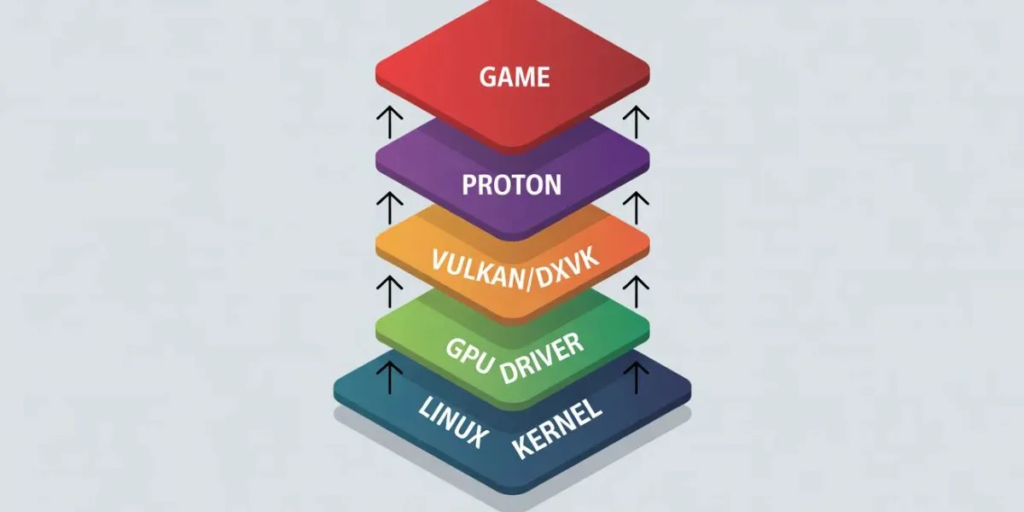
The “PB” framing signals Performance Boost. That framing matters because it sets the expectation correctly: these aren’t cosmetic changes. They target the layers of Linux that actually touch gaming workloads the scheduler, the graphics translation stack, and the driver power state.
Most people assume Linux gaming underperformance comes from the OS itself being weak. That’s not right. It usually comes from three misconfigured layers: the CPU governor sitting in the wrong mode, the wrong Proton build selected for a specific game, and GPU drivers not set to performance power states. Fix those three things first before touching anything else.
The CPU Layer: Governor Settings and GameMode
By default, most Linux distros ship with the CPU scaling governor set to powersave or schedutil. That’s fine for daily use terrible for gaming. When a frame needs to render in 6 milliseconds and your CPU is sitting at 40% clock speed because nothing “important” has demanded more, you get stutters.
Set the governor manually:
bash
sudo cpupower frequency-set -g performance
Or use Feral Interactive’s GameMode, which handles this automatically when a game launches. GameMode also adjusts I/O priorities, temporarily disables CPU frequency scaling limits, and can interface with GPU management on supported hardware. Install it via your package manager (gamemode on Arch/AUR, same on Fedora and Debian-based distros) and launch Steam games with:
gamemoderun %command%
in your Steam launch options.
Here’s the thing: GameMode is not magic. It won’t recover 30 FPS from a misconfigured system. But it removes the floor those random 2–3 second freezes where your CPU simply wasn’t ready.
Quick note: Some users report GameMode causing issues on certain AMD APU laptops where aggressive CPU scaling conflicts with integrated GPU memory bandwidth allocation. If you’re on a Ryzen APU (e.g., 7840U), test with and without it and benchmark both.
Proton and Compatibility: Picking the Right Build
Not all Proton versions perform the same. That sounds obvious, but most guides still just say “use Proton GE” without explaining when and why.
Proton GE (GloriousEggroll builds, available at github.com/GloriousEggroll/proton-ge-custom) includes patches that haven’t yet landed in Valve’s official Proton release media codec fixes, game-specific compatibility patches, and sometimes newer DXVK and VKD3D-Proton versions. For games with known compatibility issues or heavy DirectX 12 usage, Proton GE is frequently the better choice.
For stable, well-supported titles on Steam, Valve’s official Proton Experimental often performs on par or better because it goes through more QA.
How to select a Proton version per game:
- Open Steam → Right-click the game → Properties
- Go to Compatibility tab
- Check “Force the use of a specific Steam Play compatibility tool”
- Select your preferred Proton version from the dropdown
That’s it. No terminal needed.
Quick Comparison Proton Builds:
| Option | Best For | Key Benefit | Limitation |
| Proton Stable (e.g., 9.0) | Well-supported Steam titles | Tested, consistent | Slower to get new patches |
| Proton Experimental | Bleeding-edge game support | Latest Valve fixes | Occasional regressions |
| Proton-GE | Games with media/codec issues, DX12 heavy titles | Community patches, faster DXVK | Manual install required |
| Wine (standalone) | Non-Steam Windows apps | Broad compatibility | No Proton-specific patches |
GPU Drivers: NVIDIA vs. AMD in 2026 The Part Most Guides Skip
This is where competitor articles fall short. Let’s be specific.
AMD (Mesa drivers):
Mesa 24.x, shipping with most up-to-date distros in 2026, includes ACO (the AMD compiler backend) enabled by default. ACO delivers significantly faster shader compilation than the older LLVM backend this matters because shader stutters on first-play are one of the most common AMD Linux gaming complaints.
If you’re on AMD, verify your Mesa version:
bash
glxinfo | grep “OpenGL version”
You want Mesa 24.0 or later. On Arch/Manjaro this is typically current. On Ubuntu LTS you may need the oibaf PPA or a Flatpak Steam for the latest Mesa.
Set RADV_PERFTEST=gpl in your environment for games using Vulkan this enables Graphics Pipeline Library support that can further reduce stutter.
NVIDIA (proprietary drivers):
NVIDIA’s 555.x series drivers (released late 2024) introduced improved explicit sync support for Wayland, which previously caused serious tearing and input latency issues on GNOME and KDE Wayland sessions. If you’re gaming on Wayland with NVIDIA and you haven’t updated past 550.x, that’s your problem.
In nvidia-settings, set PowerMizer to “Prefer Maximum Performance” this prevents the card from downclocking during load transitions, which shows up as micro-stutters.
Enable Threaded Optimization for OpenGL titles. For Vulkan (the majority of Proton games), the driver handles threading differently no manual setting needed.
Some experts argue that AMD is categorically better for Linux gaming because of the open-source driver stack. That’s valid for raw driver reliability and community support. But if you’re already on NVIDIA hardware, the 555+ driver series closes most of the practical gap especially for Wayland users.
NTSync: The Optimization Most 2026 Guides Haven’t Covered Yet
Here’s something both major competitor articles completely missed.
NTSync is Valve’s implementation of NT synchronization primitives for Linux it replaces the older esync and fsync methods for handling Windows synchronization objects in Proton. The practical effect: reduced CPU overhead and measurably less stutter in multi-threaded games.
NTSync requires a kernel that supports it (Linux 6.14+ has it merged upstream) and a Proton build that uses it. As of early 2026, Proton Experimental and recent Proton-GE builds both support NTSync. To verify your kernel version:
bash
uname -r
If you’re on 6.14 or later and using a supported Proton build, NTSync activates automatically. No manual flag needed.
Or maybe I should say it this way esync/fsync were workarounds. NTSync is the actual solution. If you’re still reading guides that only mention esync, those guides are outdated.
[IMAGE: Terminal output showing uname -r and verifying NTSync-capable kernel]
Kernel Choice: Vanilla, Zen, or Liquorix?
The stock kernel is fine for most users. I’ve seen conflicting data on this some benchmarks show Zen kernel gains of 8–15% in CPU-bound scenarios, others show under 3% in GPU-limited games. My read is that kernel choice matters most in CPU-bottlenecked titles and competitive multiplayer games where input latency is measurable.
Zen/Liquorix kernels (liquorix.net) use a more aggressive scheduler tuned for desktop responsiveness. The benefit is lower latency, not raw throughput. For fast-paced games where input timing matters think CS2, Valorant via Lutris, or any competitive title it’s worth testing.
For most single-player games on mid-range hardware, the vanilla kernel is sufficient. Spend your tuning time on Proton and GPU settings first.
MangoHud: You Can’t Fix What You Don’t Measure
MangoHud is a Vulkan and OpenGL overlay that displays real-time FPS, GPU usage, CPU usage, frame time, VRAM consumption, and temperature all in-game. It’s the diagnostic layer that lets you see whether your bottleneck is CPU-side, GPU-side, or VRAM-limited.
Install via package manager, then add to your Steam launch options:
mangohud %command%
Look if you’re seeing 95%+ GPU usage with 30% CPU usage, your GPU is the ceiling and no CPU governor tweak will help. If it’s flipped, that’s your CPU bottleneck and GameMode + governor settings become your priority. MangoHud tells you which fight you’re actually in.
Best Linux Distros for Gaming in 2026: Short Answer
The distro debate is real but overblown for gaming specifically.
Arch Linux / Manjaro give you the freshest Mesa, kernel, and Proton versions with minimal delay. If you’re comfortable in the terminal, Arch is the best gaming platform in terms of up-to-date packages.
Fedora 40+ is the strongest option for users who want current packages with a more stable base. Fedora ships recent Mesa and kernel versions on release.
Ubuntu 24.04 LTS is the most user-friendly but ships with older Mesa by default. Add the oibaf PPA or use Flatpak Steam to get current Mesa/Vulkan support.
Pop!_OS is worth mentioning specifically for NVIDIA users System76 maintains NVIDIA driver support carefully and the out-of-box NVIDIA experience is the best of any mainstream distro.
Voice Search Q&A
What’s the best way to boost FPS on Linux gaming in 2026?
Set your CPU governor to performance mode, use GameMode, select the right Proton or Proton-GE build per game, and update GPU drivers. These four steps cover the most common performance gaps.
How do I use Proton GE on Steam?
Download the latest Proton-GE release from GitHub (GloriousEggroll/proton-ge-custom), extract it to ~/.steam/root/compatibilitytools.d/, restart Steam, and select it per-game under Properties → Compatibility.
Should I use a custom kernel for Linux gaming?
Only if you’re CPU-bottlenecked or playing competitive titles where input latency matters. For most users, GPU driver and Proton tuning delivers more return than a kernel switch.
Why does my Linux game stutter even with a good GPU?
Shader compilation stutter is the most common cause it happens on first run. Enable shader pre-caching in Steam settings and use DXVK async or Proton-GE builds that include stutter-reduction patches.
When should I use NTSync instead of esync or fsync?
Use NTSync if you’re on Linux kernel 6.14+ with a compatible Proton build. It reduces CPU overhead in multi-threaded games and replaces esync/fsync entirely you don’t need to run all three.