
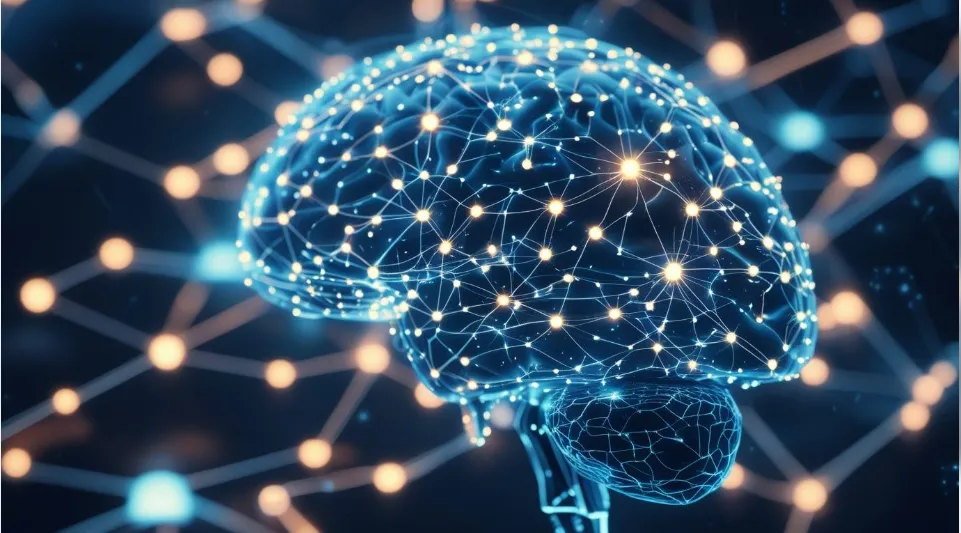
What is a neural network, and how does it help computers recognize patterns, process information, and make predictions? This beginner-friendly guide explains artificial neural networks, neural network architecture, machine learning, deep learning, and the relationship between biological neurons and artificial intelligence. You will also discover how neural networks are trained, what they are used for, and how they support modern generative AI applications.
Last updated: November 2026.
Understanding Neural Networks and How They Learn
Artificial intelligence is becoming an important part of everyday technology. From voice assistants and recommendation systems to facial recognition and generative AI tools, many modern applications depend on technologies that can recognize patterns and learn from information.
One of the most important technologies behind these capabilities is the neural network.
If you have ever wondered how a computer can recognize a photograph, understand spoken language, identify suspicious financial transactions, or generate a response to a question, neural networks provide part of the explanation.
Understanding what is a neural network does not require an advanced mathematics or computer science background. The basic idea is relatively simple: a neural network processes information through interconnected computational units and learns patterns by adjusting the strength of connections between those units.
This guide explains the structure, working process, different types, real-world applications, benefits, and limitations of neural networks. It also explores their relationship with machine learning, deep learning, and generative AI.
1. What Is a Neural Network?
A neural network is a computational model used in artificial intelligence and machine learning to recognize patterns, analyze information, and produce predictions or other outputs.
It consists of interconnected computational units called artificial neurons, which are organized into layers. These neurons receive information, perform mathematical calculations, and pass their results to other neurons.
The network learns from training data by adjusting internal parameters called weights and biases. Through repeated training, it can improve its ability to identify patterns and perform a particular task.
For example, imagine teaching a computer to recognize photographs of cats.
Instead of manually programming every possible cat shape, color, and position, you provide the system with many labeled photographs. The neural network analyzes the examples and gradually learns patterns that help distinguish cats from other objects.
After training, it can examine a new photograph and estimate whether it contains a cat.
This is the fundamental idea behind artificial neural networks: learning useful patterns from data instead of relying entirely on manually written instructions.
What Is a Neural Network in AI?
In artificial intelligence, a neural network is a machine-learning technique that allows computer systems to learn relationships within data.
AI is the broader field concerned with building systems that perform tasks associated with intelligence. Neural networks are one of the methods used to develop these systems.
They can help computers:
- Recognize objects in photographs.
- Understand and process human language.
- Identify patterns in financial transactions.
- Convert spoken language into written text.
- Predict values using historical information.
- Generate text, images, audio, and other content.
Not every AI system uses a neural network. Some artificial intelligence applications rely on rules, search algorithms, or other computational techniques.
Neural networks are particularly useful when the relationships within data are complicated and difficult to describe using traditional programming rules.
Artificial Neural Networks vs. Biological Neural Networks
The term neural network comes from the biological nervous system.
The human brain contains billions of biological neurons that communicate through specialized connections called synapses. These neurons receive signals, process information, and transmit signals to other cells.
Artificial neural networks borrow the general idea of interconnected information-processing units.
However, an artificial neuron is a mathematical computation, not a miniature biological brain cell.
| Biological neural network | Artificial neural network |
|---|---|
| Contains biological neurons | Contains computational units |
| Communicates through electrochemical signals | Processes numerical values |
| Uses biological synapses | Uses mathematical weights |
| Learns through biological changes | Learns by updating parameters |
| Operates within nervous systems | Runs on computing hardware |
This distinction is important because artificial neural networks are inspired by the brain but do not reproduce all its biological functions.
2. How Does a Neural Network Work?
A neural network works by receiving input data, processing that information through interconnected layers, and producing an output.
Its internal connections determine how much influence one input has on another computational unit.
During training, the network adjusts these connections to reduce the difference between its predictions and the expected results.
To understand this process, imagine a system designed to identify spam emails.
The network receives information about an email, examines different features, processes them through its layers, and produces a prediction about whether the message is spam or legitimate.
The Three Main Layers of a Neural Network
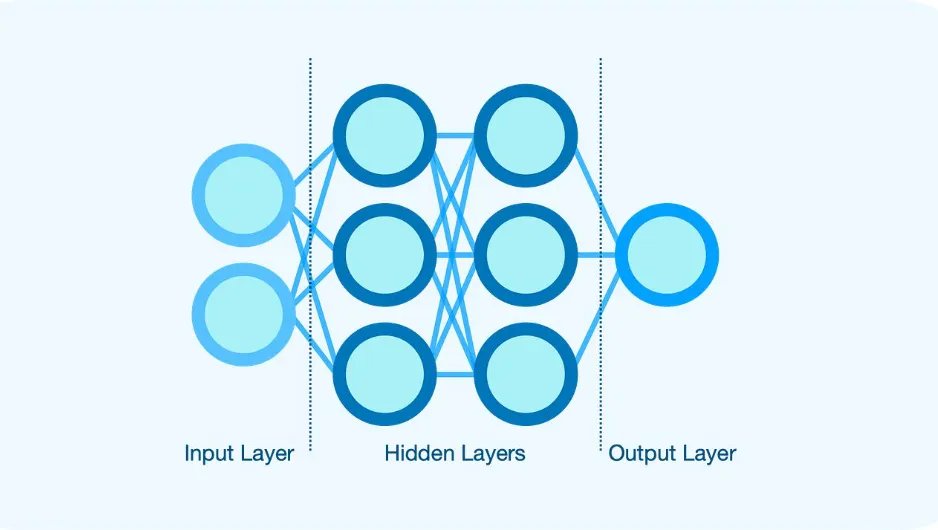
Most introductory explanations describe a basic neural network using three main layer categories.
1. Input Layer
The input layer receives the information that the neural network needs to process.
For an image-recognition model, inputs might represent pixel values. For a spam-detection model, they might represent the presence of certain words, message characteristics, or other numerical features.
The input layer makes the information available to the following layers.
2. Hidden Layers
Hidden layers process the information received from earlier layers.
Each artificial neuron performs calculations using its inputs, weights, and bias. It then applies an activation function and passes the result forward.
A network can contain one or multiple hidden layers. More complex networks may contain many layers that learn different levels of representation.
For example, in an image-recognition system:
- Earlier layers may detect edges and simple visual patterns.
- Intermediate layers may recognize shapes and textures.
- Later layers may combine these features into more meaningful representations.
This is a simplified illustration of how hierarchical feature learning can work.
3. Output Layer
The output layer produces the network’s final result.
Depending on the task, the output might be:
- A category, such as spam or legitimate email.
- A numerical prediction, such as estimated demand.
- A probability distribution across several possible classes.
- A sequence of generated text tokens.
The output layer converts the information processed by earlier layers into a result that can be used by another system or presented to a user.
What Are Weights and Biases?
Weights and biases are important parameters that influence how a neural network processes information.
Weights determine the strength of connections between computational units. A larger positive weight can increase the influence of an input, while a negative weight can reduce or reverse its contribution.
Biases are additional numerical parameters that help adjust a neuron’s activation threshold or output.
Together, weights and biases allow a neural network to learn different relationships within its training data.
For example, in an email classification system, certain combinations of words and message features may become more useful for identifying suspicious messages than others.
The network learns these relationships by updating its parameters during training.
What Is an Activation Function?
An activation function is a mathematical function applied to a neuron’s calculated input.
Its purpose is to introduce nonlinear behavior into the network, allowing it to learn relationships more complex than a simple linear transformation.
Common activation functions include:
- ReLU (Rectified Linear Unit): Returns zero for negative inputs and passes positive inputs through.
- Sigmoid: Converts an input into a value between zero and one.
- Tanh: Produces values between negative one and positive one.
- Softmax: Converts a collection of output scores into a probability distribution.
Different activation functions are useful for different network components and tasks.
3. How Are Neural Networks Trained?
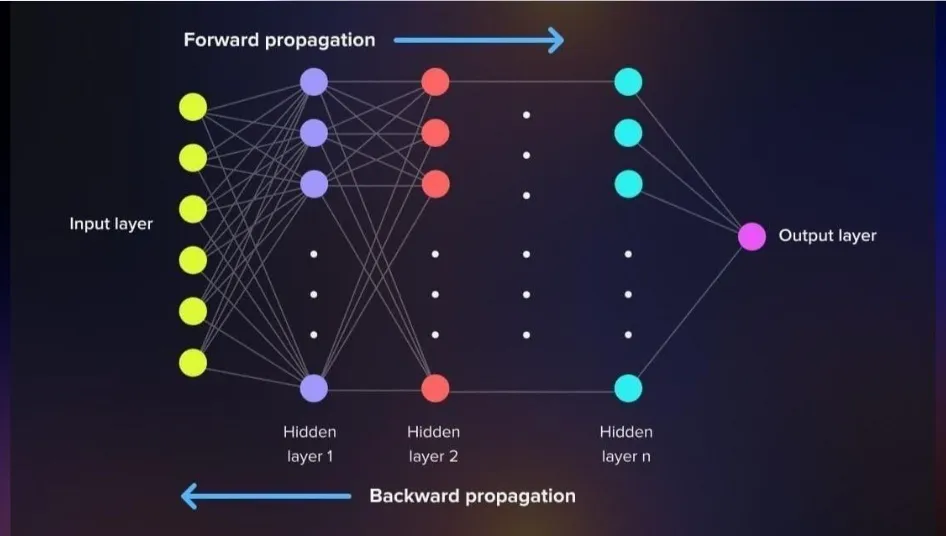
Training is the process through which a neural network learns patterns from examples.
Instead of receiving every possible instruction manually, the network makes predictions and adjusts its parameters based on how well those predictions match the expected results.
Most introductory supervised-learning examples involve four important stages.
For the full step-by-step version — all seven steps, from collecting data to testing the trained model — see our guide to how neural networks learn.
Step 1: Provide Training Data
The first step is collecting and preparing relevant data.
For example, if the objective is to identify handwritten numbers, the training dataset may contain thousands of images representing digits from zero to nine.
Each image is paired with its correct label.
The quality and diversity of the training data matter because the network learns from the examples it receives.
If you are new to training data, our guide to what a data set is in AI explains what a data set contains, the main types, and how to clean one.
Step 2: Forward Propagation
During forward propagation, information moves from the input layer through the hidden layers toward the output layer.
Each neuron calculates a weighted combination of its inputs, adds a bias, and applies an activation function.
The network then produces a prediction.
For example, an image classifier might predict that a particular image contains the number seven.
Step 3: Calculate the Error
The network’s prediction is compared with the correct answer.
A loss function measures how far the prediction is from the expected result.
If the correct label is seven but the network predicts two, the model receives a relatively large error signal.
The purpose of the loss function is to provide a measurable objective that the training process can attempt to minimize.
Step 4: Backpropagation and Weight Updates
Backpropagation calculates how changes in the network’s parameters affect the loss.
An optimization algorithm, such as gradient descent, then uses these gradients to update weights and biases.
The network repeats this process across many training examples and iterations.
Over time, the model can improve its performance on the task it was trained to perform.
Training vs. Prediction
Training and prediction are two different stages.
| Training | Prediction (inference) |
|---|---|
| Learns from training data | Processes new input data |
| Updates model parameters | Usually uses learned parameters |
| Measures and reduces errors | Produces an output |
| Can require repeated iterations | Runs when a prediction is needed |
A trained network does not necessarily keep learning from every new prediction. Some systems are retrained periodically, while others use additional learning mechanisms.
Understanding this difference helps explain how a model can be trained in a development environment and later used inside an application.
4. What Is a Neural Network in Machine Learning?
A neural network is one type of machine-learning model.
Machine learning is a field within artificial intelligence that enables systems to learn patterns from data and use those patterns to make predictions or decisions.
Traditional machine-learning approaches can include decision trees, linear regression, support vector machines, and neural networks.
The main difference is how these models represent and learn relationships in data.
For example, a decision tree makes predictions through a sequence of decision rules. A neural network uses interconnected computational units and learned parameters to transform input information into an output.
Neural networks can be especially useful when working with complex data, including images, audio, and natural language.
However, they are not automatically the best solution for every machine-learning problem. Simpler algorithms may be easier to train, interpret, and maintain for certain datasets.
What Is the Relationship Between AI, Machine Learning, and Neural Networks?
These concepts are connected but do not mean the same thing.
- Artificial Intelligence (AI): The broader field of intelligent computer systems.
- Machine Learning (ML): An approach that enables systems to learn patterns from data.
- Neural Networks: A family of computational models used within machine learning.
- Deep Learning: Machine learning that uses neural networks with multiple processing layers.
In simple terms, AI is the broader field, machine learning is one approach within AI, neural networks are one family of machine-learning models, and deep learning uses deeper neural network architectures.
5. What Is a Neural Network in Deep Learning?
Deep learning is a specialized area of machine learning that uses neural networks with multiple layers to learn complex patterns.
The word deep refers to the depth of the network, particularly its hidden processing layers.
A simple neural network may have only a small number of layers, while a deep neural network can contain many layers and millions or even billions of learned parameters.
Deep learning is especially useful when working with large and complex datasets.
For example, a computer-vision system may learn to identify visual patterns through several processing stages. A language model may learn relationships between words, tokens, and longer sequences of text.
How Deep Learning Differs From Traditional Machine Learning
Traditional machine-learning workflows often require people to identify and prepare useful features manually.
Deep-learning systems can learn many useful representations directly from raw or lightly processed data.
This can make deep learning powerful for complicated tasks, although it often requires more data, computing resources, and careful evaluation.
Not every machine-learning problem needs deep learning. For a small dataset with clearly defined features, a simpler model may deliver better practical results.
6. Different Types of Neural Networks
Neural networks come in different architectures. Each architecture is designed to process particular kinds of information or solve particular problems.
1. Feedforward Neural Networks
A feedforward neural network is one of the simplest architectures.
Information moves in one direction, from input to output, without recurrent connections.
These networks can be used for classification and regression tasks, such as predicting numerical values or assigning categories to data.
2. Convolutional Neural Networks (CNNs)
Convolutional neural networks are commonly used in image-processing applications.
They use convolutional operations to identify spatial patterns, such as edges, shapes, textures, and objects.
Common applications include:
- Image classification.
- Object detection.
- Facial recognition.
- Medical image analysis.
- Industrial quality inspection.
3. Recurrent Neural Networks (RNNs)
Recurrent neural networks were designed to process sequential information.
They use recurrent connections that allow information from earlier steps to influence later processing.
They have been used for:
- Speech recognition.
- Time-series forecasting.
- Sequential data analysis.
- Language-processing tasks.
RNNs have important limitations when handling long sequences, and other architectures, particularly transformers, have become prominent for many modern sequence-processing applications.
4. Transformer Neural Networks
Transformers are neural network architectures built around attention mechanisms.
Instead of relying on traditional recurrent processing, they use attention to calculate relationships between different parts of an input sequence.
Transformers are important in modern natural language processing and generative AI.
They support applications such as:
- Large language models.
- Text generation.
- Machine translation.
- Document summarization.
- Conversational AI.
- Code-generation systems.
Transformers have become particularly influential because they can process sequence relationships efficiently and support large-scale training.
7. What Is a Neural Network Used For?
Neural networks are used in many industries because they can learn complicated patterns from different forms of data.

Here are some important real-world applications.
Image Recognition and Computer Vision
Neural networks can analyze images to identify objects, faces, text, and visual patterns.
For example, a photo application might automatically recognize people, animals, buildings, and other objects.
In manufacturing, image-processing systems can help detect defects in products. In healthcare, appropriately validated models can assist professionals with analyzing medical images.
These applications demonstrate how neural networks can turn visual information into useful predictions.
Natural Language Processing
Natural language processing (NLP) allows computer systems to work with human language.
Neural networks support several NLP tasks, including:
- Language translation.
- Text classification.
- Sentiment analysis.
- Question answering.
- Text summarization.
- Conversational assistants.
For example, a customer-support application can use a language model to interpret a written question and generate a relevant response.
Speech Recognition
Speech-recognition systems convert spoken language into text or structured commands.
Neural networks can analyze audio signals, recognize speech patterns, and identify words.
Examples include voice assistants, automatic transcription tools, and voice-controlled applications.
Healthcare
Neural networks can support selected healthcare applications by identifying patterns in medical data.
Examples include:
- Medical image analysis.
- Research into disease prediction.
- Processing certain clinical datasets.
- Supporting medical research workflows.
These systems require careful validation, appropriate data protection, and professional oversight. A model’s prediction should not automatically be treated as a medical diagnosis.
Finance and Fraud Detection
Financial institutions can use neural networks to analyze transaction patterns and identify unusual activity.
For example, a model may examine transaction amounts, locations, timing, and historical behavior to estimate whether a payment is suspicious.
Neural networks can also support forecasting, risk analysis, and other financial modeling tasks.
Recommendation Systems
Recommendation systems use information about user activity, preferences, and item characteristics to suggest relevant content or products.
Examples include:
- Movie recommendations.
- Music suggestions.
- Online shopping recommendations.
- Personalized content feeds.
Neural networks are one approach to building these systems, although other recommendation techniques are also widely used.
Generative AI
Generative AI systems use trained models to produce new content.
Many modern generative AI systems rely on neural networks.
For example, large language models use transformer-based neural networks to process text and generate responses. Image-generation systems can use neural-network architectures to produce images from learned patterns.
This is why understanding neural networks provides a useful foundation for learning how modern generative AI works.
8. What Is a Neural Network in Generative AI?
Generative AI focuses on producing new content, including text, images, audio, video, and code.
Neural networks provide the underlying learning and generation mechanisms for many of these systems.
For example, a large language model processes text represented as tokens and learns statistical relationships that help it predict subsequent tokens.
When a user submits a question, the model processes the input and generates a response based on its learned parameters and the context provided.
Different generative AI systems use different architectures:
| Generative AI model | Neural network approach | Common output |
|---|---|---|
| Large language models | Transformers | Text and code |
| Diffusion models | Neural denoising networks | Images, audio and other media |
| GANs | Generator and discriminator networks | Synthetic data and images |
| Variational autoencoders | Encoder-decoder networks | Learned data representations and generated samples |
Neural networks do not simply store complete answers to every possible question. They learn patterns and relationships from training data, then use those learned parameters to generate outputs.
This also explains why generative AI can sometimes produce incorrect or misleading information. A convincing response is not automatically a verified fact.
To see what these systems can actually do, read our guide to generative AI tasks and examples for beginners — seven everyday tasks, from writing to image creation.
9. A Simple Neural Network Example for Beginners
Let’s use an everyday example to understand how a neural network works.
Imagine an email service that wants to identify spam messages automatically.
The system receives an email and examines several features:
- Does the subject contain suspicious words?
- Does the message include unusual links?
- Does the sender have a suspicious history?
- Does the email contain repeated promotional language?
- Does its structure resemble previously identified spam?
These features are converted into numerical inputs that a neural network can process.
The input layer receives the information. Hidden layers analyze combinations of features, and the output layer produces a prediction.
For example, the network might estimate a 94% probability that a particular email is spam. This is an illustrative prediction, not a guaranteed result.
During training, the network compares its predictions with labeled examples and updates its parameters to improve its performance.
After training, the email service can use the model to classify new messages.
This is a practical neural network example because it demonstrates the entire process without requiring advanced mathematics.
10. Benefits of Neural Networks
Neural networks offer several advantages that make them useful in modern artificial intelligence.
Ability to Learn Complex Patterns
They can identify complicated relationships in data that may be difficult to represent using manually written rules.
Adaptability Through Training
Their parameters can be updated through training, allowing the model to improve its performance on a defined task.
Processing Different Data Types
Different architectures can process images, text, audio, numerical information, and sequential data.
Automation
Neural networks can help automate repetitive classification, prediction, and recognition tasks.
In business, this automation often becomes a full workflow. Our guide to intelligent automation shows seven real examples — from invoice processing to customer support — where neural networks do the reading and deciding.
Support for Advanced AI
They provide the foundation for many deep-learning applications, including modern language models and generative AI systems.
11. Limitations and Challenges of Neural Networks
Despite their capabilities, neural networks have limitations that developers and organizations must consider.
Data Requirements
Training a useful model may require large amounts of relevant, representative, and accurately prepared data.
Poor-quality or based data can lead to unreliable results.
High Computing Requirements
Large neural networks can require significant processing power, memory, storage, and energy.
Training advanced models may be expensive and time-consuming.
Overfitting
Overfitting happens when a model learns training examples too closely and performs poorly on unfamiliar data.
For example, an image classifier might memorize characteristics of its training photographs rather than learning patterns that generalize to new images.
Developers use techniques such as regularization, dropout, and separate validation datasets to help reduce this problem.
Limited Explainability
Complex neural networks can be difficult to interpret.
Even when a model produces accurate predictions, understanding exactly why it reached a particular result may be challenging.
This is especially important in high-impact areas such as healthcare, finance, and public services.
Bias and Unreliable Predictions
If training data contain systematic biases or fail to represent real-world conditions, a model may produce unfair or inaccurate results.
Neural networks can also make confident predictions that are incorrect.
Consequently, testing, monitoring, and human oversight remain important when deploying these systems.
12. How Beginners Can Start Learning Neural Networks
If you want to learn how neural networks work beyond theoretical explanations, follow a structured learning path.
Step 1: Understand Basic Artificial Intelligence Concepts
Start by learning the differences between AI, machine learning, and deep learning.
Step 2: Learn Python Programming
Python is widely used in machine learning because it has a large ecosystem of data-processing and model-development libraries.
Step 3: Understand Basic Mathematics
Learn basic algebra, functions, probability, and introductory statistics. Linear algebra and calculus become increasingly useful as you study more advanced neural network concepts.
Step 4: Study Machine Learning Fundamentals
Understand datasets, features, labels, classification, regression, training, testing, and model evaluation.
Step 5: Explore Neural Network Architecture
Learn about neurons, weights, biases, activation functions, hidden layers, and backpropagation.
Step 6: Build a Simple Project
Try creating a basic handwritten-digit classifier or a small spam-detection model using an educational machine-learning library.
Step 7: Explore Deep Learning and Generative AI
Once you understand the fundamentals, explore CNNs, transformers, and other neural network architectures.
A useful starting point is Google’s free Machine Learning Crash Course. It introduces neural networks, hidden layers, activation functions, and training concepts.
13. The Future of Neural Networks
Neural networks continue to influence the development of artificial intelligence.
Researchers are exploring new architectures, improved training methods, more efficient computing techniques, and ways to make models more reliable.
Several areas are particularly important.
Multimodal AI
Models are increasingly designed to process different types of Ai information, including text, images, audio, and video.
Efficient AI Models
Researchers are exploring ways to reduce the computing resources required for training and running neural networks.
Scientific Applications
Neural networks can help researchers analyze complex datasets and investigate problems in areas such as biology, physics, and materials science.
Responsible AI
Improving model transparency, reducing bias, evaluating reliability, and protecting data remain important challenges.
The future of neural networks will depend not only on making models larger or more powerful but also on making them useful, efficient, understandable, and reliable.
Frequently Asked Questions
1. What is a neural network in simple words?
A neural network is a computer model that learns patterns from data using interconnected artificial neurons. It processes information through layers and adjusts internal parameters during training to improve predictions.
2. What is a neural network used for?
Neural networks are used for image recognition, speech processing, language translation, fraud detection, recommendation systems, forecasting, and generative AI applications.
3. Is a neural network the same as artificial intelligence?
No. Artificial intelligence is the broader field, while neural networks are one technique used within machine learning and AI. Not every AI system uses a neural network.
4. What is the difference between a neural network and deep learning?
A neural network is a computational model containing interconnected processing units. Deep learning uses neural networks with multiple processing layers to learn more complex representations from data.
5. What is a biological neural network?
A biological neural network is a collection of interconnected biological neurons found in the brain and nervous system. These neurons communicate through electrochemical signals and support functions such as perception, memory, and movement.
6. How does a neural network learn?
A neural network learns by processing training examples, comparing its predictions with expected results, calculating errors, and adjusting its weights and biases using optimization techniques such as gradient descent.
7. Are neural networks used in generative AI?
Yes. Many generative AI applications use neural networks, including transformer-based language models and neural diffusion models. These systems learn patterns from data and use them to generate new content.
8. Do neural networks work like the human brain?
Neural networks are inspired by biological neurons and their connections, but they are mathematical models implemented on computers. They do not reproduce the full complexity or biological functioning of the human brain.
9. How do I keep up with new neural network research?
New architectures and results appear regularly. Our guide to the latest AI news explains how to find reliable updates, check the original source, and tell a real advance from a hyped headline.
Conclusion
Understanding what is a neural network provides an important foundation for learning how modern artificial intelligence works. These computational models use interconnected artificial neurons, processing layers, weights, biases, and activation functions to recognize patterns and generate predictions from data.
Neural networks are an important part of machine learning and form the foundation of deep learning. Their applications range from image recognition and speech processing to financial analysis, recommendation systems, and generative AI.
However, their capabilities come with challenges, including data requirements, computing costs, overfitting, bias, and limited explainability. Understanding these limitations is just as important as learning their advantages.
For beginners, the best approach is to start with basic AI and machine-learning concepts, understand how neural network layers operate, and then explore simple practical projects.
As you develop this knowledge, you will have a stronger foundation for understanding deep learning, large language models, and the technologies shaping modern artificial intelligence.
Related reading: How Neural Networks Learn, What Is a Data Set in AI? A Beginner’s Guide, and What Is the Purpose of AI?
Related reading: What Is Generative AI? Tasks and Examples for Beginners, Intelligent Automation: 7 Easy AI Examples for Beginners, and Latest AI News.
Related reading: How to Learn Machine Learning: A Complete Beginner’s Roadmap







9 Comments